Energy Transition Index 2026


1. Framework
The 2026 Energy Transition Index provides a comparative framework for a holistic assessment of national energy systems and tracking energy transition progress.
The global energy landscape is increasingly complex and uncertain. Heightened geopolitical tensions, supply shocks, evolving trade dynamics and persistent economic pressures are reshaping national priorities, with countries recalibrating their approach to energy security, equity and sustainability. As these forces intensify, the direction and pace of the energy transition are becoming more complex and uneven across regions and systems. It is precisely because the landscape is shifting that a consistent, multidimensional framework becomes even more valuable. A stable analytical lens makes it possible to distinguish structural trends from short-term volatility and compare progress across different national contexts.
The ETI provides a structured, data-driven view of the energy transition, designed to remain relevant across changing conditions by measuring both system outcomes and the enabling factors shaping them. The ETI builds on over 15 years of tracking and comparing countries’ performance at the World Economic Forum. It offers a data-driven framework using 44 indicators to assess both how energy systems perform today and how prepared they are for the future. Covering 120 countries, the ETI evaluates current energy system performance across equity, sustainability and security, as well as five readiness factors (Figure 1).
By spanning both what energy systems deliver today and the conditions that will determine future progress, the framework captures shifts in the transition environment as they materialize, even when the nature of the pressures changes from one year to the next. The ETI captures the inherent trade-offs within energy systems and highlights the extent to which countries can balance competing priorities. It provides a consistent and comparable lens through which decision-makers can assess performance, identify gaps and better understand the conditions required to deliver a resilient, inclusive and sustainable energy transition.
A country’s ETI score is a weighted composite of two sub-indices: system performance (60%) and transition readiness (40%). System performance is evenly distributed across equity, security and sustainability, while transition readiness is divided into two categories: core enablers and enabling factors. Core enablers include regulation and political commitment as well as finance and investment, while enabling factors encompass innovation, infrastructure, and education and human capital.
Figure 1: ETI framework
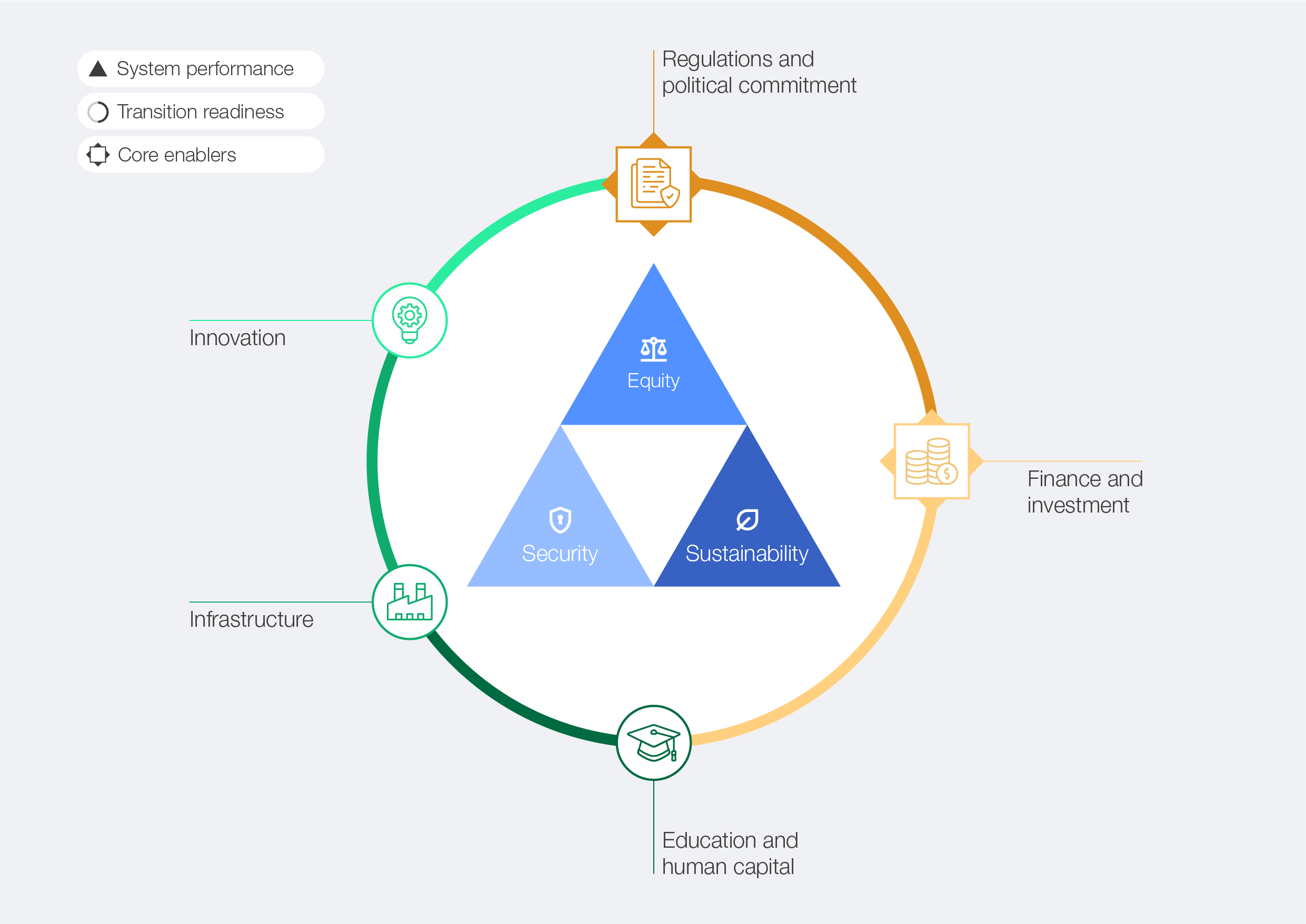

The evaluation of a country’s energy system performance is centred on three key imperatives that form the basis of how this report views energy transition:
- Security: Ensuring a stable and resilient energy supply through diversification (across the energy mix, trade partners and electricity generation sources), grid and power supply reliability, and robust infrastructure to enhance adaptability to external shocks
- Equity: Providing access to energy for all (consumers and industries), energy affordability and price stability while supporting economic growth and development
- Sustainability: Advancing the environmental performance of energy systems to support a low-emissions, resource-efficient and clean energy future – this is achieved by reducing CO2 and methane intensity, lowering energy per capita and emissions footprints, and increasing the share of clean energy in final demand through balanced demand- and supply-side measures
These dimensions are inherently interdependent, and progress in one may result in both win-win and trade-off outcomes in others. The ETI framework emphasizes the importance of achieving balanced outcomes across all three.
A country’s energy transition progress also depends on its transition readiness – the strength of the enabling environment that supports long-term transformation. Transition readiness is driven by the following five core enablers:
- Regulations and political commitment: Creating robust and stable policies and regulations that are essential for promoting a competitive energy market
- Infrastructure: Ensuring the physical and digital infrastructure is robust and flexible enough to support the transition to a low-carbon economy
- Education and human capital: Developing a skilled workforce capable of meeting the emerging clean energy sector’s demands
- Innovation: Developing cutting-edge technologies in energy systems, essential for sustainability and security
- Finance and investment: Ensuring a sustainable financial ecosystem that can attract investments at scale to support energy transformation
Together, these factors largely determine a country’s ability to translate ambition into implementation and sustain progress over time.
In the 2026 edition, the framework has been further strengthened through the addition of two new indicators, “AI readiness” and “clean technology minerals supply chain exposure”, reflecting the growing importance of digital capabilities and strategic resources in shaping the transition. The ETI now evaluates countries using 44 indicators that capture key aspects of the energy transition. The data was sourced from many different organizations, with an emphasis on ensuring data quality through the relevance, coverage, comparability, recency and quality of sources.
Results reflect the latest available data at the time of collection. The addition of two new indicators had a negligible impact on the 2026 overall results (-0.03% reduction), keeping the overall trajectory broadly unchanged. Moreover, while no index can fully capture all the factors and complex realities impacting energy systems and transitions, the ETI’s breadth provides a solid basis for comparing countries, identifying gaps and tracking trends over time. It spans critical system performance outcomes alongside key enabling conditions.
The ETI offers a comprehensive framework, but it is important to note that external factors can influence outcomes. These include commodity market fluctuations, geopolitical developments, international climate action, financial market conditions, as well as supply chain constraints and technological progress, which are reflected in the index only as they materialize in the underlying data. As such, scores should be interpreted as reflecting both performance outcomes and enabling conditions, in the context of each country’s structural characteristics and development pathway, rather than as a real-time measure of short-term performance (Box 1).
For more information, see the annex for an overview of ETI methodology, indicators and country coverage.
Box 1: Key terms of the ETI methodology
Score reference: All scores in this report (from individual indicators to the overall index) are based on a 0 to 100 scale, with 100 being the highest possible value. Scores reflect the most recent data and updates available at the time of production.
System performance score: This score reflects how a country’s energy system performs based on the latest statistical data in terms of sustainability, security and equity, using 22 indicators to provide an overall picture.
Transition readiness score: This score reflects how prepared a country is to support future energy transition needs, using 22 indicators that assess enabling factors such as regulation, infrastructure, the capital and investment environment, human capital and innovation capacity.
Global and regional averages: References to global, regional or overall scores for the index or its components refer to the simple average of all country scores, not adjusted for size, gross domestic product (GDP) or population unless noted.