The Global Cooperation Barometer 2026 – Third Edition


The overall level of global collaboration has held steady in the face of sustained pressure but its shape is changing as geopolitical tensions, conflict and fragmentation strain traditional multilateral approaches. Cooperation is advancing where it is targeted, interest-based and regional, offering a picture of what collaborative approaches can look like in a new geopolitical context.
The Global Cooperation Barometer 2026 provides a comprehensive assessment of global cooperation across five pillars: trade and capital, innovation and technology, climate and natural capital, health and wellness, and peace and security. Drawing on 41 indicators, the report highlights where cooperation is persisting, where it is weakening and how it is being reconfigured in response to shifting economic, political and technological realities.
The findings underscore the need for more adaptive, pragmatic approaches to cooperation in an increasingly uncertain landscape. For business and government leaders alike, understanding these evolving patterns is critical to strengthening resilience, managing risk and advancing shared prosperity.
The overall level of global collaboration has held steady in the face of sustained pressure but its shape is changing as geopolitical tensions, conflict and fragmentation strain traditional multilateral approaches. Cooperation is advancing where it is targeted, interest-based and regional, offering a picture of what collaborative approaches can look like in a new geopolitical context.
The Global Cooperation Barometer 2026 provides a comprehensive assessment of global cooperation across five pillars: trade and capital, innovation and technology, climate and natural capital, health and wellness, and peace and security. Drawing on 41 indicators, the report highlights where cooperation is persisting, where it is weakening and how it is being reconfigured in response to shifting economic, political and technological realities.
The findings underscore the need for more adaptive, pragmatic approaches to cooperation in an increasingly uncertain landscape. For business and government leaders alike, understanding these evolving patterns is critical to strengthening resilience, managing risk and advancing shared prosperity.
Key findings
Global cooperation holds steady, but its shape is evolving.
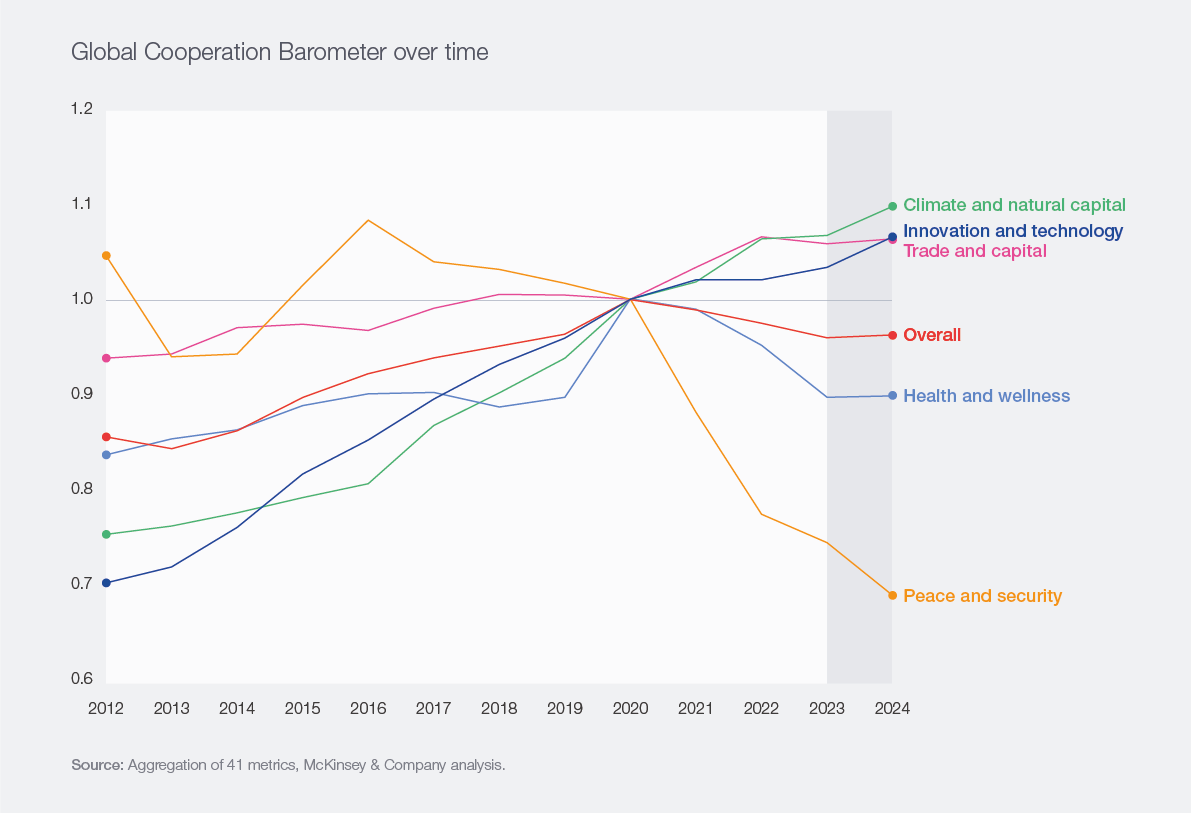
The 2026 Global Cooperation Barometer’s level of overall cooperation was largely unchanged from previous years, but the composition of cooperation appears to be changing. Metrics relating to multilateralism weakened most. Metrics in which more flexible and smaller arrangements of cooperation can operate – in data flows, services trade and select capital flows, for example – have continued to grow, including in 2025. These dynamics are visible in each of the five pillars of the barometer:
– Trade and capital cooperation flattened. Cooperation remained above 2019 values, but its makeup is shifting. Goods volumes grew, albeit slower than the global economy, and flows are shifting to more aligned partners. Services and select capital flows show momentum, particularly among aligned economies, especially where they can contribute to bolstering domestic capabilities. While the global multilateral trade system faces rising barriers, smaller coalitions of countries are cooperating through initiatives such as the Future of Investment and Trade (FIT) Partnership.
– Innovation and technology cooperation rose to unlock new capabilities even amid tighter controls. IT services and talent flows are up, and international bandwidth is now four times larger than before the COVID-19 pandemic. Restrictions on flows of critical resources, technologies and knowledge expanded – especially, but not only, between the US and China. However, new cooperation formats are rising, with instances of cooperation on artificial intelligence (AI), 5G infrastructure and other cutting-edge technologies among aligned countries.
– Climate and natural capital cooperation grew, but is still short of global goals. Increased financing and global supply chains stimulated deployment of clean technologies, which reached record levels in mid-2025. While China accounted for two-thirds of additions of solar, wind and electric vehicles, other developing economies stepped up. As multilateral negotiations become more challenging, groups of nations – for example, the European Union (EU) and ASEAN (Association of Southeast Asian Nations) – are combining decarbonization with energy security goals.
– Health and wellness cooperation held steady, with outcomes resilient for now, but aid is under severe pressure. Topline cooperation in this pillar did not fall, in part because health outcomes continued to improve after the end of the COVID-19 pandemic. Although health outcomes have stayed resilient, the stability masks growing fragility. Pressures on multilateral organizations have eroded support flows, and development assistance for health (DAH) contracted sharply – with further tightening in 2025 – affecting low and middle-income countries most acutely.
– Peace and security cooperation continued to decrease, as every tracked metric fell below pre-COVID-19 pandemic levels. Conflicts escalated, military spending rose and global multilateral resolution mechanisms struggled to de-escalate crises. By the end of 2024, the number of forcibly displaced people reached a record 123 million globally.1 Still, growing pressures are creating an impetus for increased cooperation – including through regional peacekeeping mechanisms.
Since key challenges and important opportunities cannot be addressed by individual countries alone, leaders should anticipate shifts and move proactively to “re-map” international engagement; strengthen resilience by building new capabilities; and find new forums to cooperate – matching the right format to the right issue.
Figure 2: Global Cooperation Barometer over time