As senior leaders from business, government, academia and civil society gather this week in Nay Pyi Taw, Myanmar, for the World Economic Forum on East Asia, the host country’s strategy for growth will be at the centre of discussions. One of the core questions will be: how can a country that is changing so swiftly – economically, socially and politically – create equitable and sustainable growth, employment creation and resource security?
One indisputable piece of this puzzle is access to energy. As United Nations Secretary-General Ban Ki-moon has stated,
Sustainable energy is the ‘golden thread’ that connects economic growth, social equity, and a climate and environment that enables the world to thrive.
Myanmar has an uphill climb: 74% of the country’s population still lives without electricity. In rural areas, where 40 million people live, energy access is barely 16%. And to make the climb even steeper, experts estimate that energy demand in Myanmar will double within the next five years.
How will Myanmar be able to increase its electrification rates in a way that can first catch up and then keep pace with the country’s rapid development?
While much of the energy demand will be met in the long term through large-scale hydropower, natural gas and coal-fired plants powering the national grid, the case for off-grid renewable energy solutions can’t be ignored, particularly in the short term, considering that two-thirds of the population lives in rural areas.
In contrast to comparatively slow-moving national grid extensions, off-grid energy solutions – primarily through solar PV, small hydropower and biomass – offer the opportunity for fast, flexible, expandable and cost-effective energy access.
President Thein Sein has stated that the government will take a “people-centered” approach to the country’s growth and development.
If Myanmar is going to hold true to this promise – which includes providing reliable, affordable electricity to its people – off-grid renewable energy needs to have a significant place in the national electrification strategy.
Without it, Mr. Ban’s proverbial “golden thread”, along with its social, economic and environmental benefits, will continue to remain out of reach for millions of people in Myanmar.
Author: Simon Henschel, a Social Entrepreneur with the Schwab Foundation, is COO of Sunlabob Renewable Energy, Ltd
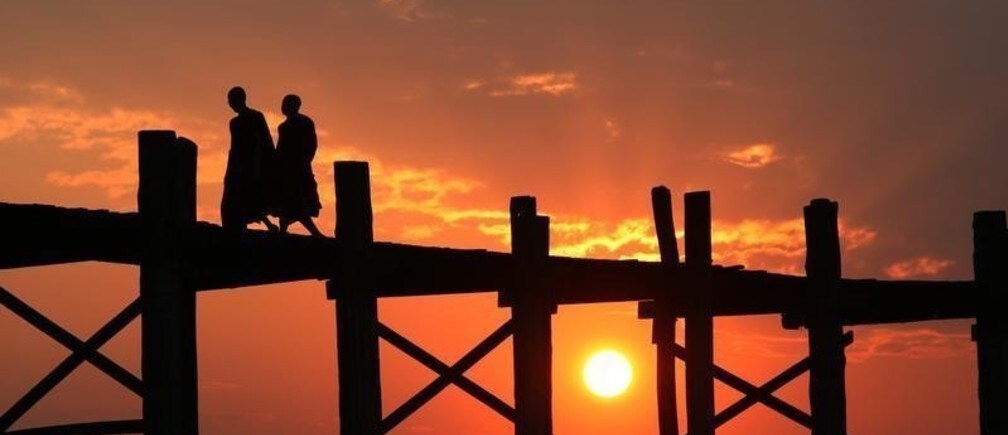
Image: Monks walk along an ancient teak bridge at Amarapura, near Mandalay. REUTERS/Ed Cropley