
As hundreds of leaders meet in Medellín for the World Economic Forum on Latin America, here are some of the top economic and finance issues they’ll be discussing.
1. Growth and investment outlook in Latin America’s “new normal”
This year, a number of Latin American economies face recession as a result of weaker external demand, further declines in commodity prices, volatile financing conditions and some key domestic imbalances.
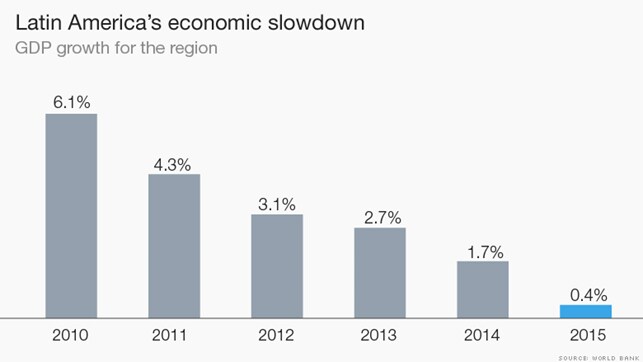
How will inflation outcomes be managed in different economies across the region in the year ahead? What will be the relationship between the public debt dynamics and corporate vulnerabilities across the region? How can the cost of investing in Latin American markets be reduced? And how will 'multi latinas' now continue to grow and reach new markets? Some economies in the region are already executing a policy mix that manages the transition to lower commodity prices in pressing current account deficits to sustainable levels; others are just starting on that path. The meeting will feature a series of high-level economics and finance discussions with leaders from government and business.
Watch: Global Economic Outlook: the Impact on Latin America, A New Growth Model for Latin America, Developing Colombia’s capital market
2. New regional and “mega-regional” trade
Latin America remains particularly vulnerable to a stronger-than-expected slowdown in China - the destination of 15-25% of the exports from a number of countries in the region. Meanwhile, the trade outlook for Mexico, much of Central America and the Caribbean benefits from a more robust US recovery in recent years. Aside the tale of two Latin American trading regions, there are a number of cross regional issues that will be discussed at the meeting, related to the geopolitical impact of mega-regional trading agreements; what higher value added trade can mean in the post-commodity era in principle and practice, and finally how regional businesses specifically can further partake in global value chains that the region is part of.
Watch: Mega-Regional Trade Agreements and Integration
3. From leading on microfinance to winning with fintech in Latin America
In Latin America, sectors such as agribusiness are beginning to incorporate big data integration for operating and business model improvements into their workflows. The same goes for the financial services industry, which has seen a dramatic drop in the price of machine intelligence. It’s also benefitted from the spread of smartphones and internet access, which has helped more people than ever before access financial services. Tune in on 17 June for an update on how financial technologies in Latin America are increasing the efficiency and transparency of financial services, as well as reducing their cost.
Watch: Bytes, Payments and Bitcoin
4. The new urban growth agenda
Last but not least, Medellín, the host city of the meeting, is a most amazing urban innovation story itself. More than half of the world’s population lives in a city – and many of them are neither sustainable nor secure.
On the economic agenda, leaders across government and business are searching for solutions to finance and properly manage urban infrastructure projects. Mayors, technologists, investors, developers and architects will meet in Medellín to develop sustainable solutions for urban habitats. What urban planning models are the best way to build safe urban spaces? What municipal finance solutions will best contribute to the long-term pool of capital required? Could new technologies – for example the blockchain for efficient land and property management – support broad-based economic growth in cities of the future?
Watch: Urban Life at a Cross-Roads
The World Economic Forum on Latin America is taking place in Medellin, Colombia from 16 to 17 June.
Have you read?
It's time for Latin America to forge its own future, and here's how
6 powerful lessons from the transformation of Medellin
Latin America’s cities: unequal, dangerous and fragile. But that can change