
Twitter is not a reliable way to predict election results, according to a new study.
Twitter mentions are a measure of the interest generated around a candidate, and do not indicate how many votes they will receive, researchers found. They emphasise that this interest does not necessarily translate into votes.
“Negative events, such as political scandals, as well as positively evaluated events, such as accomplishments, can [both] underlie attention for a party or candidate,” explain the study authors.
Why isn’t Twitter a useful prediction tool?
The joint study by researchers from University Mannheim, University of Bamberg and Johannes Gutenberg-University in Mainz, Germany, examined the 2013 German federal election and highlighted two reasons why attention on Twitter doesn't correlate with electoral success.
Data about Twitter mentions is a far more accurate indicator of levels of interest in a particular candidate, rather than support or voting intentions. For example, volume of mentions could surge as a video gaffe goes viral. Clearly, this is unlikely to result in increased political support.
Equally, the volume of mentions varies heavily depending on daily events. Televised debates, interviews, or the coverage of controversies and scandals are all likely to lead to a surge in mentions.
The second reason is Twitter’s “highly skewed” demographic. The user base is likely to be younger, focused on millennials voters, and therefore unrepresentative of the population as a whole.
However, a Twitter spokesman argued that the study is not relevant to the 2016 U.S. presidential election.
"I'd advise passing the next time someone sends along German Twitter data from three years ago in the context of the 2016 U.S. election," said Nick Pacilio, a spokesman for the social media site's government and news department.
Pacilio cited a Time magazine website report that showed Twitter chatter favored the winning candidates, Democrat Hillary Clinton and Republican Donald Trump, in the Iowa caucuses this month.
What could we use instead?
Data has suggested that Google searches are a far more accurate prediction tool.
The search giant has been releasing real-time results of search data during the current US presidential elections for the first time.
Searches conducted in New Hampshire ahead of the state’s primary correlated closely to the final results. For example, Democrat Bernie Sanders won with 60% of the vote and 72% of searches were about him, compared to 38% of the vote and 28% of searches for Hillary Clinton.
Among Republicans the results were even more striking, as highlighted by Google Data Editor Simon Rogers.
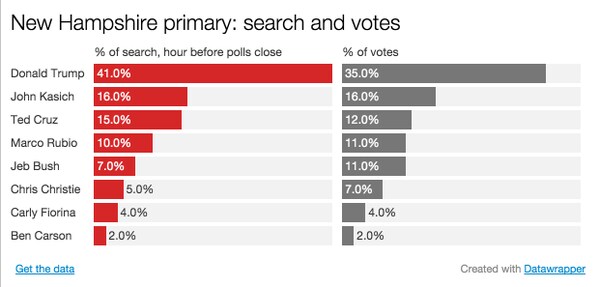
So next time you want to predict the future, maybe you should just google it.
Have you read?