Government R&D budgets in the European Union grew 6% between 2020 and 2021 to just over $109 billion, Eurostat data shows.
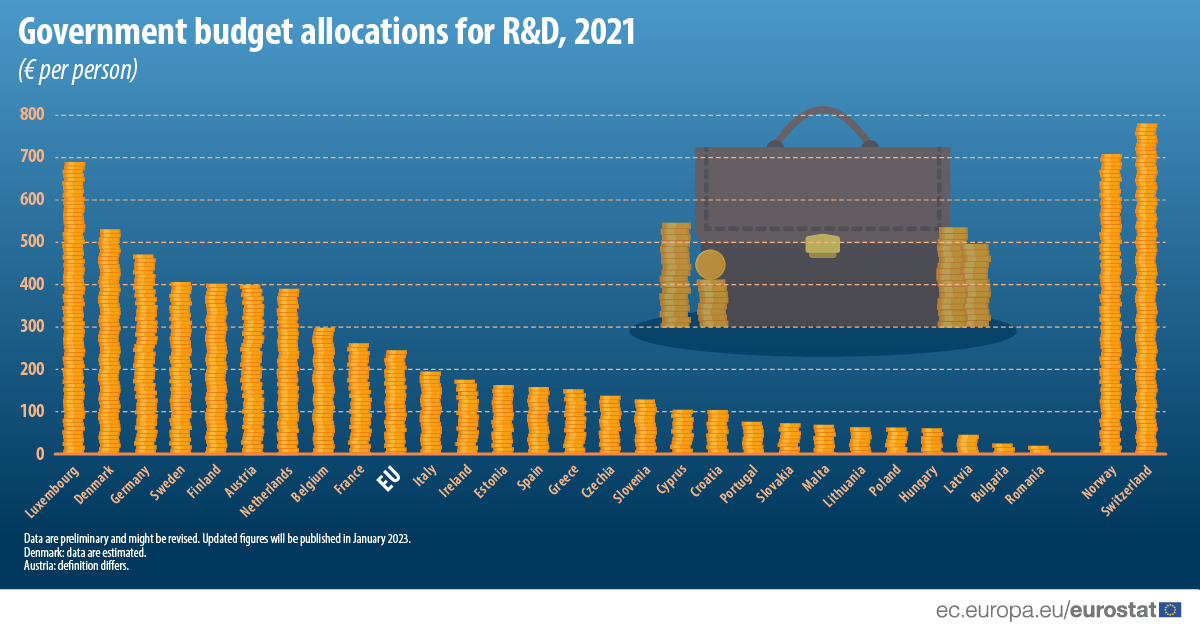
Luxembourg, Denmark and Germany had the EU’s highest budget allocations for R&D in 2021.
Investing in research and innovation boosts the competitiveness of EU economies and the welfare of its citizens, says Eurostat.
Governments in Europe are increasing their research and development (R&D) budgets, new data shows.
Between 2020 and 2021, R&D budgets across the 27-country European Union grew 6% from $102.7 billion to $109 billion, finds Eurostat, the EU’s statistical office.
Luxembourg had the highest R&D budget allocation per head in 2021, at $689 per person. Denmark and Germany “followed at a distance,” Eurostat says, with $530 and $471 allocated respectively to research and development.
Europe’s innovation commitment
R&D is central to many European and country-level policies designed to boost the “competitiveness of EU economies and the welfare of its citizens,” Eurostat explains.
Investing in “disruptive research and breakthrough innovation” in areas including artificial intelligence, data and digital technologies is a key goal of the European Commission, the EU’s government.
Growing R&D budgets
Romania, Bulgaria, Latvia and Hungary had the EU’s lowest R&D budget allocation in 2021, at $19, $24, $45 and $60 per person respectively.
But Latvia and Hungary were also among three countries showing the biggest percentage jumps in R&D budget allocation over the past decade. Latvia’s budget rise from $14 in 2011 to $45 in 2021 was the biggest, at 221%. Greece increased its budget allocation 162% from $58 to $152 and Hungary doubled its budget over the same period from $30 per head.
Spain saw a slight drop in R&D budget allocation per head, from $155 in 2011 to $152 in 2021, a fall of 1.9%.
Across the European Union as a whole, government budget allocations for research and development are up 35% from 2011, when R&D budgets stood at just over $81 billion.
Global research and development spenders
Globally, the world’s top three spenders on research and development are Israel, South Korea and Switzerland, according to World Bank data from 2017 and 2018.
Sweden, Japan, Austria, Germany, Denmark, the United States and Belgium make up the rest of the top 10 for those years.
In 2019 alone, $2.3 trillion was spent globally on R&D, according to McKinsey & Company. This roughly equates to 2% of global GDP. Industry accounted for about half of this spending, with the rest coming from governments and academic institutions.

Why R&D spending matters
Investing in research and development is important because it can identify improvements in processes and efficiency, as well as potential cost savings, says ForrestBrown, a UK tax relief consultancy.
Optimal R&D budgets can also help businesses develop new products and services to “survive and thrive” in competitive markets.
Since the COVID-19 pandemic, innovation has become increasingly important, the World Economic Forum argues. One of its initiatives is Global Innovators, a community of start-ups and scale-ups focused on technological and business model innovations.
“It is a critical moment for innovative companies to bring forward new ideas and innovations to help protect the lives and livelihoods of communities and industries around the world,” the Forum says.