
While powerful people perform well when they work alone, this isn’t always the case when they work together.
Researchers from the University of California undertook a series of experiments and found that “power hampers the ability of leaders to work with other leaders”.
Feeling powerful allows individuals to process information more effectively, think more creatively and focus for longer stretches of time, but these benefits don’t apply when powerful people come together.
For one experiment, the researchers randomly assigned positions of power to the participants. They were then assigned tasks, with the "leaders" given power over a "worker". The next phase involved grouping together leaders, workers and participants in a controlled condition.
It emerged that the group of leaders was the least creative, with independent judges rating their group the least innovative and the most uninspired.
This finding was consistent across experiments. Powerful individuals working alone performed much better than others. However, when they worked together with other high-powered individuals they struggled to complete tasks and performed worse than other groups.
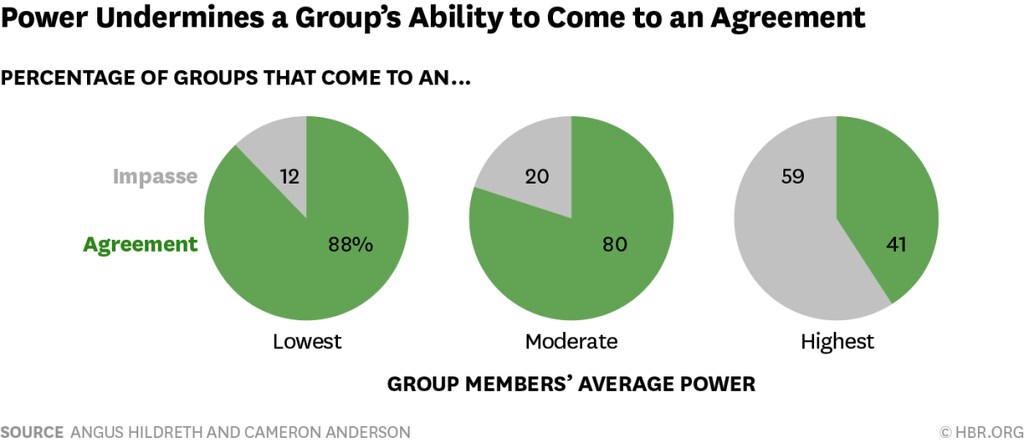
The study grouped together executives, with the most powerful together in the first group, the next most powerful in the second group and so on.
The group with the most high-powered executives underperformed considerably in comparison to the less powerful groups.
When asked to take part in a negotiation and come to an agreement, less than half of the groups consisting of the most powerful individuals were able to reach an agreement, whereas almost 90% of the groups consisting of the least powerful executives were able to.
Groups of leaders were more likely to argue over their status within the group, were less focused on the task and had trouble sharing information with one another.
“While the possession and experience of power can make individuals more capable than others on individual tasks,” the study notes, “that same power appears to undermine their ability to get along and work with each other on collaborative tasks.”
According to the authors, John Angus Hildreth and Cameron Anderson, their study could help to explain why groups of powerful individuals often fail when they work together.
“Interaction among the powerful is vulnerable to conflict and miscommunication that undermines their collective performance.”
Have you read?
The 5 keys to engaging your team
How should leaders build creative teams?
Are successful teams always harmonious?