After the last decade's housing market crash, scholars, analysts, and policy makers stepped up efforts to better understand how households' attitudes toward the housing market, such as their optimism or pessimism, influence house price fluctuations. While some have argued that market mood swings play a key role in the trajectory of sales and prices, it has been hard to quantify that influence or to pinpoint its sources.
In Social Networks and Housing Markets (NBER Working Paper No. 22258), Michael Bailey, Ruiqing Cao, Theresa Kuchler, and Johannes Stroebel explore whether discussions with members of one's social network about the housing market can influence one's decision about whether to buy a home, and at what price to do so. They find that the housing market experiences of a person's friends can have large effects on that person's housing market beliefs and housing investment decisions, even if these friends live far away.
To measure individuals' housing market beliefs, Facebook conducted an online survey of some of its users in Los Angeles County, the most populous county in the United States. The survey was conducted in November 2015, and yielded 1,242 responses from 113 L.A. zip codes. The researchers analyzed the responses, and found that individuals whose friends experienced larger recent house price increases considered local property a more attractive investment, with bigger effects on the beliefs of those respondents who regularly discussed such investments with their friends.
The researchers then compiled anonymized social network data from Facebook, combined with public housing deeds and assessor records, in an effort to analyze the relationships between the home price experiences of a person's friends and four actual housing decisions: whether to rent or own, the square footage of properties bought, the price paid for a particular house, and the leverage chosen to finance the purchase. The final data contained anonymized demographic, social network, and housing market data for 1.4 million individuals and 525,000 housing transactions.
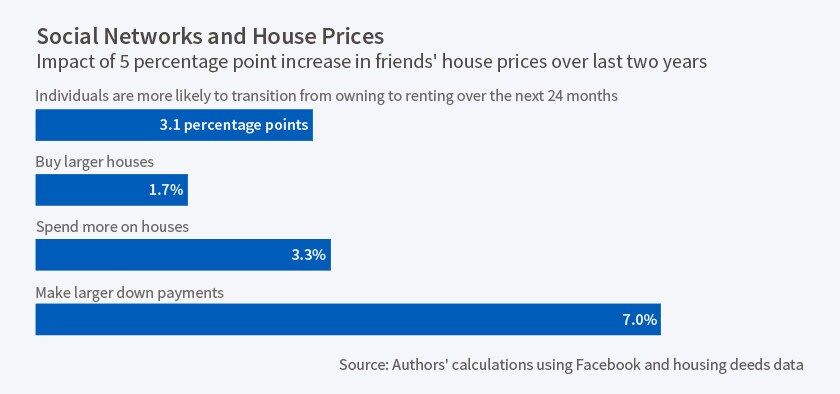
The researchers found that a 5 percentage point larger house price increase over the previous 24 months in the communities where an individual's friends lived raised that individual's likelihood of moving from renting to owning by 3.1 percentage points over the next 24 months. Such a price increase was also associated with a 1.7 percent increase in the average size of the home purchased, a 3.3 percent increase in the amount paid for the house, and a 7 percent larger down payment. When someone's friends experienced less-positive house price changes, those individuals were more likely to become renters, and more likely to sell their property at lower prices.
The researchers conclude that their findings "can contribute to our understanding of the geographic contagion of house price shocks."