Thousands of Ebola survivors with little to no risk of re-infection are critical to controlling the epidemic and training them has the potential to save thousands of lives and decrease the spread of the virus, experts said on Wednesday.
Survivors have developed immunity and are effectively the only people in the world protected from the virus, which could allow them to care for the sick without risking their lives, said experts in the International Journal of Epidemiology.
The worst Ebola outbreak on record has killed 6,331 in the three worst hit countries Guinea, Liberia and Sierra Leone, and infected 17,800, including 7,719 in Liberia and 7,798 in Sierra Leone, the World Health Organization said.
“In a sense survivors are the only people in the world who are ‘vaccinated’ against further Ebola infection with the strain in circulation,” Zena Stein of the HIV Center for Clinical and Behavioral Studies at the New York State Psychiatric Institute wrote in an editorial.
“This uniquely positions them to mediate between the infected and uninfected and between local people and foreign responders.”
As survivors speak local languages and are familiar with local culture, they might also be seen more favorably than outsiders by local communities who often mistrust foreigners, chasing away health workers and shunning treatment, said the paper.
Community-based epidemic response – like an HIV campaign in South Africa – has been effective in turning survivors into advocates and educators and helping to tackle stigma and gain trust.
Although survivors could still face stigmatizing by their communities, people were starting to see them as a real sign of hope and help, the children’s agency UNICEF has noted.
Creating jobs by employing Ebola survivors as caregivers might also be beneficial for sub-Saharan Africa’s , which has been hit by an estimated $3-$4 billion in financial damage through the virus outbreak.
Survivors can also donate their blood as their antibodies might be protective and help those infected to survive the virus, the experts said, even though this has not yet been proven to be effective.
With a case recovery rate of around 30 percent for the current epidemic, there are already thousands of survivors whose immunity can be established through blood tests.
This article is published in collaboration with The Thomson Reuters Foundation trust.org. Publication does not imply endorsement of views by the World Economic Forum.
To keep up with Forum:Agenda subscribe to our weekly newsletter.
Author: Magdalena Mis joined Thomson Reuters Foundation in 2011 and works as a production editor.
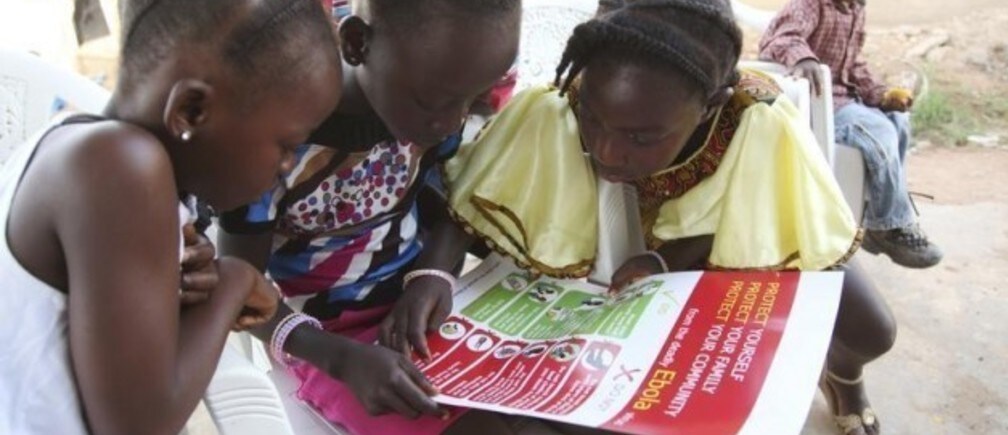
Image: Girls look at a poster, distributed by UNICEF, bearing information on and illustrations of best practices that help prevent the spread of Ebola. REUTERS/Ahmed Jallanzo/UNICEF/Handout via Reuters.


