
Japan is not exactly the country that comes to mind as a model of gender equality and high labor force participation for women. In 1995, the OECD estimated women’s employment rate in Japan at 56.5 percent, almost 10 percentage points lower than in the U.S., which had an employment rate of 66 percent for women at the time. Between 1995 and 1999, the employment rate for Japanese women grew by less than half a percentage point, while for women in the U.S. it grew by almost 3 percentage points.
However, since 2000 this trend completely reversed. Between 2000 and 2015, the employment rate for women in Japan increased by almost 14 percentage points, while in the U.S. it dropped by over 6 percentage points. Japan’s employment rate for women surpassed the U.S. in 2014. Currently, almost 65 percent of Japanese women are employed, while only about 63 percent of women in the US are employed.
In recent years, Japan has launched extensive campaigns to encourage labor force participation by women. The government took various steps such as increasing allowances given to new parents, subsidizing daycare, and ensuring both mothers and fathers benefit from paid parental leave.
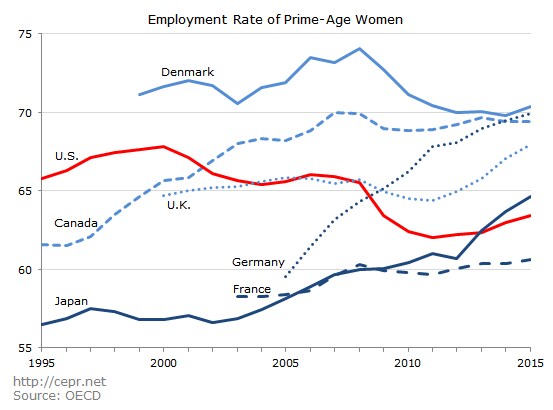
A look at the employment rate for women in some other OECD countries over time shows that other countries had increases similar to Japan’s. The only country besides the U.S. where the participation of women in the labor force has decreased since 2000 is Denmark, which has seen a 1.8 percentage point drop in the employment rate of women. Despite this drop however, Denmark still boasts one the highest employment rates for women of any country in the world.
In Germany, Japan, Canada, France, and the U.K. the employment rate for women has been increasing. In the last 10 years, German women have seen the biggest gains in their employment rate, which increased by 17 percentage points. The increases in the other countries have been more modest: 2 percentage points for Canada, 11 percentage points for Japan, 4 percentage points for France, and 3 percentage points for the U.K.
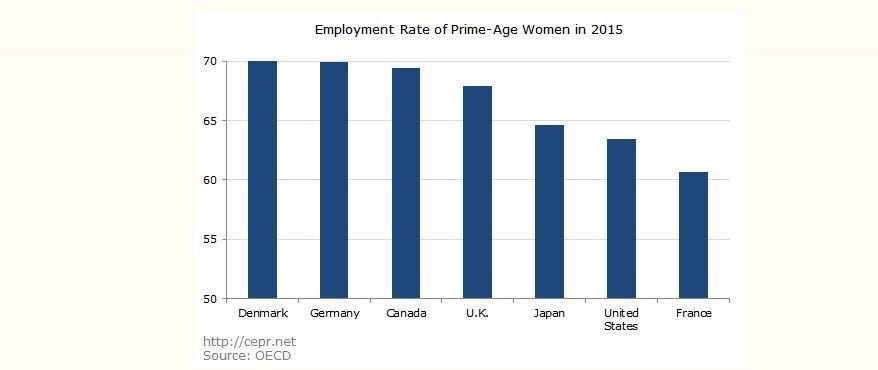
By 2015 only France had a lower employment rate for women than the U.S. While France still trails behind the U.S., it has made progress in the past 10 years. The employment rate for women is on a steady upwards trend, meaning it could surpass the U.S. in the near future.
What all other countries besides the U.S. have in common is fairly generous parental leave policies for new parents. While in the U.S. new parents have no guarantee of paid leave, in Japan both mothers and fathers can take up to 58 weeks of paid leave. New mothers are guaranteed 58 weeks of paid leave in Germany, 52 in Canada, 50 in Denmark, 42 in France, and 39 in the U.K. For new fathers, France offers 28 weeks of paid leave, Germany, nine weeks, and the U.K. and Denmark, two weeks.
Furthermore, child care costs in the U.S. are extremely high, and are growing at a much faster pace than overall inflation. The rising costs of childcare make it unaffordable for many parents, especially for low-wage workers. The Economic Policy Institute found that childcare costs in some areas can take up more than a quarter of a family’s income. In some states, costs for daycare are higher than for college tuition.