For a discussion on the future of the economy, watch the Global Economic Outlook session at the World Economic Forum's Annual Meeting 2017 here.
In addition to collecting taxes, governments also borrow money in order to meet their spending obligations.
For a lot of developed countries, this is usually in the realm of millions or trillions of US dollars, numbers that we might struggle to comprehend.
For example, the gross national debt of Japan is $ 10,000,000,000,000.
The gross national debt of the United States is $18,992,810,000,000.
This map seeks to make those numbers a bit more understandable, by looking at the debt relative to the country's population. In other words, by showing how much we would each owe if it were up to us to pay it back.
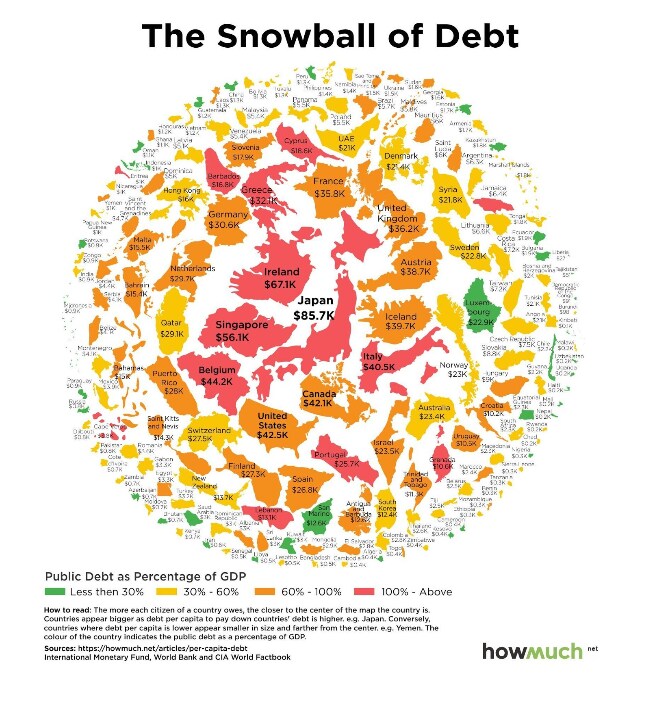
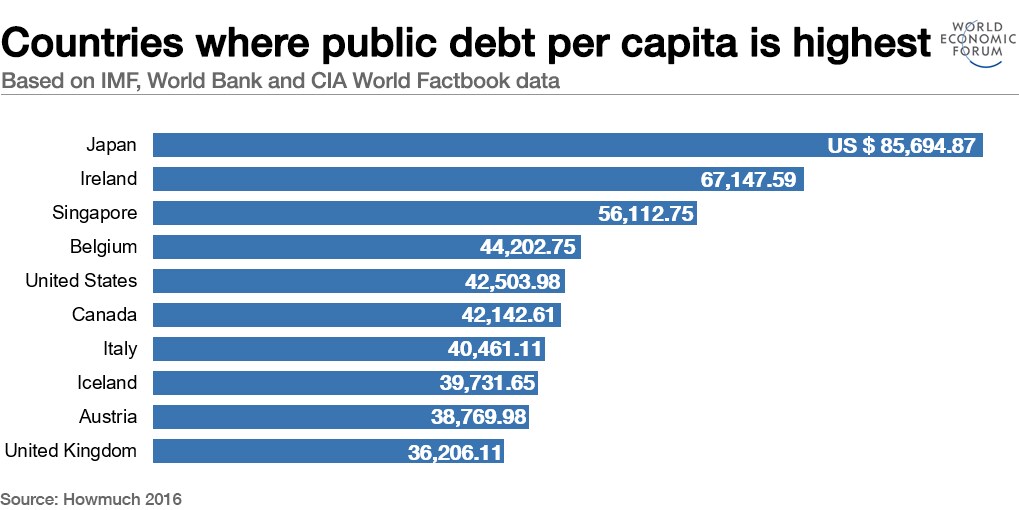
At the centre of the globe are those countries which owe the most. For example, every person in Japan would have to pay a whopping $85,694.87 in order to pay off their government's debt.
Every person in Ireland would have to pay $67,147.59. In Singapore, it's $56,112.75 per person, and in Belgium, it's $44,202.75 per person.
Every American would have to pay $43,503.00.
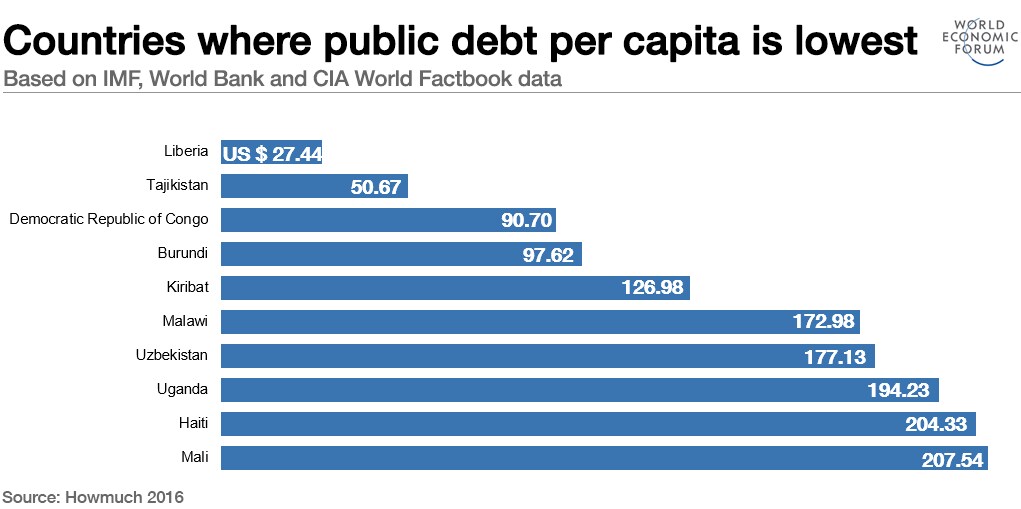
In some countries, with national debts that are much smaller, the figures are lower than $30 a person. In Liberia, for instance, a country with a national debt of 798,000,000,000, its people would have to pay back $27.44 per person. In Tajikistan, they would pay $50.67 per person and in the Democratic Republic of Congo, $90.70 per person.
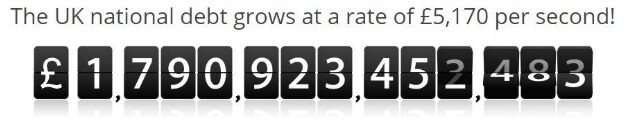
This clock is said to continually count the UK national debt, showing that it increases at a rate of £5,170 per second.
Governments borrow money to spend on investments that will boost their own economies, as well as to meet their spending obligations. In an environment of low interest rates, it's cheap for them to do so.
However, some say that the debt is unsustainable, arguing that it poses new risks to financial stability and may undermine global economic growth.