Appendix A
Definitions and Global Risks List
Definitions
For the purposes of this report, “global risk” is the possibility of the occurrence of an event or condition that, if it occurs, would negatively impact a significant proportion of global GDP, population or natural resources.
“Structural force” is the long-term shift in the arrangement of and relation between the systemic elements of the global landscape. These shifts are not risks in and of themselves, but have the potential to materially influence the speed, spread and scope of global risks. These include but are not limited to geostrategic shifts, technological acceleration, climate change and demographic bifurcation.
“Climate change” is a structural force that encompasses the trajectories of global warming and possible consequences to Earth systems, reflecting anthropogenic actions and environmental changes.
“Demographic bifurcation” is a structural force that refers to changes to the size, growth and structure of national, regional or global populations, and the resulting impact on socioeconomic and political structures. It includes, but is not limited to, migration, fertility and ageing rates.
“Geostrategic shifts” is a structural force that refers to changing geopolitical power dynamics. It encompasses global and regional alliances and relations, the offensive and defensive projection of different sources of power (including economic), and national attitudes relating to key actors, governance mechanisms and strategic goals.
“Technological acceleration” is a structural force that refers to technological developments enabled by exponential growth in computing power and analysis. It has the potential to blur boundaries between technology and humanity, and rapidly give rise to novel and unpredictable global risks.
Global risk list
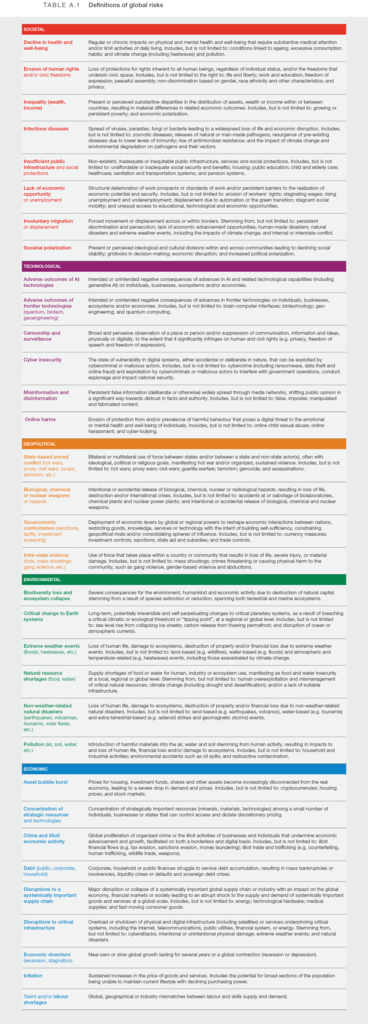
Table A.1 presents the list of 33 global risks and definitions adopted by the Global Risks Perception Survey 2025–2026.
To ensure legibility, the names of some of the global risks have been abbreviated in the figures throughout the report. The portion of the full name used in the abbreviation is in bold in Table A.1.
世界经济论坛发布的文章,可依据《知识共享署名-非商业性使用-禁止演绎4.0国际公共许可协议》以及我方《使用条款》进行转载。 本文所表达的观点仅代表作者个人立场,并不代表世界经济论坛的观点。