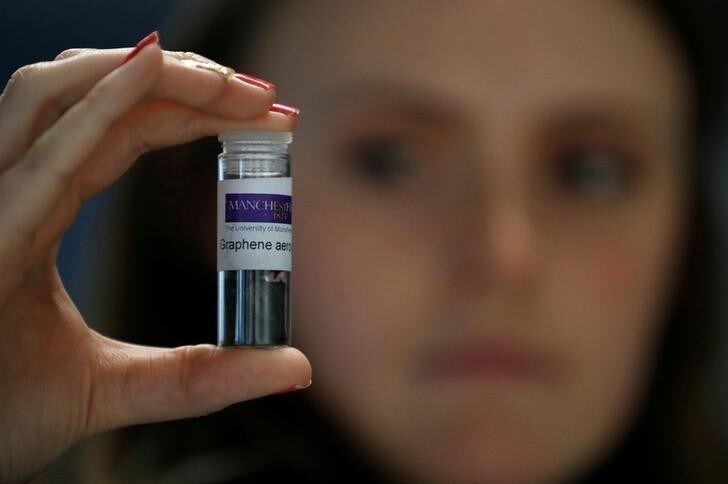
Engineers have found a simple method for producing high-quality graphene: bake the compound in a microwave oven.
“This is a major advance in the graphene field,” says Manish Chhowalla, professor and associate chair in the department of materials science and engineering in the Rutgers University School of Engineering. “This simple microwave treatment leads to exceptionally high quality graphene with properties approaching those in pristine graphene.”
Postdoctoral associates and undergraduates in the department made the discovery, says Chhowalla, who is also the director of the Rutgers Institute for Advanced Materials, Devices and Nanotechnology. The discovery appears online in the journal Science.
Graphene—100 times tougher than steel—conducts electricity better than copper and rapidly dissipates heat, making it useful for many applications. Large-scale production of graphene is necessary for applications such as printable electronics, electrodes for batteries, and catalysts for fuel cells.
Graphene comes from graphite, a carbon-based material used by generations of students and teachers in the form of pencils. Graphite consists of sheets or layers of graphene.
The easiest way to make large quantities of graphene is to exfoliate graphite into individual graphene sheets by using chemicals. The downside of this approach is that side reactions occur with oxygen—forming graphene oxide that is electrically non-conducting, which makes it less useful for products.
Removing oxygen from graphene oxide to obtain high-quality graphene has been a major challenge over the past two decades for the scientific community working on graphene. Oxygen distorts the pristine atomic structure of graphene and degrades its properties.
Chhowalla and his group members found that baking the exfoliated graphene oxide for just one second in a 1,000-watt microwave oven, like those used in households across America, can eliminate virtually all of the oxygen from graphene oxide.
The National Science Foundation, Rutgers Energy Institute, the US Department of Education, and Rutgers Aresty Research Assistant Program supported the work.