
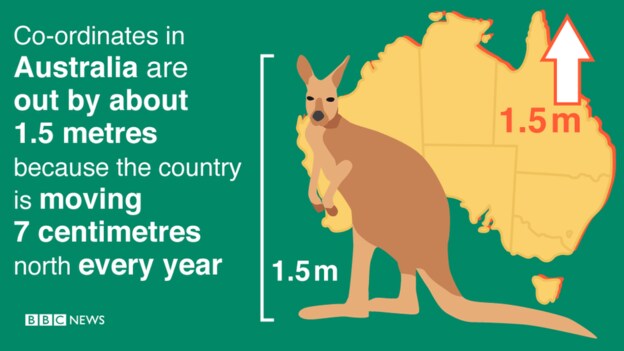
Moving something 150 centimetres doesn’t sound like a big job, but it starts to look trickier when the thing to be moved is Australia.
The good news is, while the country is indeed shifting its longitude and latitude, it is the measurements that are moving, not the landmass.
Continental drift
Australia actually creeps 7cm north each year because of tectonic plate movement.
Modern satellite GPS systems provide location data based on global lines of longitude and latitude, which do not change even if the continents on Earth shift around.
And because no adjustments have been made to the data since 1994, the difference between where Australia actually is and where GPS satellites think it is, is now 150cm.
Driving change
A 1.5-metre discrepancy isn't a huge issue for those of who just want to use Google Maps to get us home because GPS technology on our smartphones is only accurate to around 5-10 metres anyway.
But as technology improves and we start to rely on GPS to do things like navigate self-driving cars, we're going to need the measurements to be a lot more accurate.
"In the not-too-distant future, we are going to have possibly driverless cars or at least autonomous vehicles where, 1.5 metres, well, you're in the middle of the road or you're in another lane," Dan Jaksa from Geoscience Australia told ABC News.
"So the information needs to be as accurate as the information we are collecting."
With GPS playing a vital role in many of the developing technologies that will help power the Fourth Industrial revolution, the need for pinpoint accuracy is only going to increase.
One giant leap
So on 1 January 2017, the country's local co-ordinates will be shifted further north - by 1.8m.
The over-correction means Australia's local co-ordinates and the Earth's global co-ordinates will align in 2020.
At that point a new system, which can take changes over time into account, will be implemented.
For three years, the new coordinates will also be slightly out of sync while the continent catches up, but they'll be much more accurate than they are now.
Have you read?
Are we ready for self-driving cars?
How safe are robot drivers?
How new technology will improve GPS