Ask a young person today what a vinyl record is, or what a cassette deck looks like, and they may well stare blankly into the middle distance. In a world where technology develops at an ever-increasing pace, things that were once commonplace can quickly become obsolete.
Now there are early signs that even the combustion engine, lynchpin of the industrial age, might eventually be on its way to the technological graveyard.
According to the Norwegian newspaper Dagens Naeringsliv, the ruling party Framstegspartiet will ban all combustible fuel-driven cars in the country by 2025.
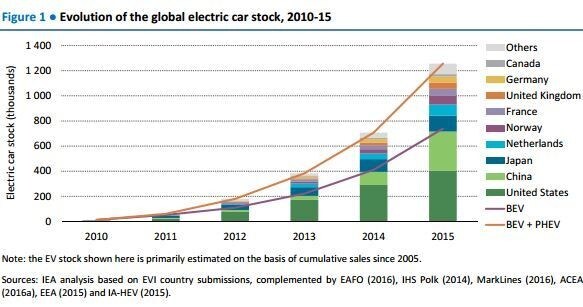
It may seem ambitious, but perhaps not impossible. Worldwide sales of electric cars are booming. According to the International Energy Agency, in 2015 the global threshold of one million cars on the road was exceeded, with 1.26 million up and running. In 2005, electric cars were still measured in hundreds.
What’s driving the electric car market?
Government initiatives are partly behind the boom in electric cars. Incentives and subsidies such as toll-free driving, free public parking, use of public transport lanes and exemptions from heavy car taxes as well as purchasing incentives have encouraged the driving public to go electric.
That’s in addition to heavy investment in the facilities needed to accommodate the cars. For instance, in January the UK Government announced a multi-million pound funding pot to encourage cities to “go green” by mounting rapid-charging hubs and street lighting that doubles as charge points, as well as creating thousands of electric car parking spaces.
At the heart of government-backed plans is their contribution to reaching international climate goals. Decreasing the pollution caused by traditional vehicles will have dramatic effects that will be two-fold – reducing early deaths caused by poor air quality and curbing emissions.
In addition, electric cars are increasingly cheaper to own. According to one report, they will be cheaper to own than conventional cars by 2022, helped mainly by the plummeting cost of batteries. Their range is increasing too: they can currently travel for up to around 100 miles, and “supercharge” facilities now offer a faster recharge of the batteries.
Cities without cars?
Going further, we could perhaps see a city without cars, giving city-dwellers cleaner air and less noise. However, obstacles remain, chiefly, whether cities can support an exponential rise in electric cars.
In Norway, for instance, the popularity of electric vehicles, and the fact that they can use bus lanes, has led to complaints about increasing congestion in these lanes.
Whilst most research has concentrated on the light vehicle market, with the transport sector responsible for about a quarter of energy-related carbon emissions, researchers are also looking at fleets of battery-powered heavy-duty trucks.
Have you read?
Which countries are speeding ahead with electric cars?
Will this breakthrough see an electric car in every driveway?
The question we should really be asking about electric cars