This article is published in collaboration with MIT News.
One of the main challenges faced by the nuclear industry is the long-term confinement of nuclear waste. Concrete is one of the barrier materials commonly used to contain radionuclides, both in nuclear reactors and nuclear waste-storing facilities. For this reason, it is extremely important that researchers and industry professionals understand the chemical and structural stability of cement (the basic binding ingredient in concrete) containing radioactive materials.
A new study by researchers from the MIT Concrete Sustainability Hub and the joint MIT-French National Center for Scientific Research (CNRS) lab known as Multi-Scale Materials Science for Energy and Environment (MSE2) is the first to show that cement is effective for nuclear containment of radioactive materials.
The paper, coauthored by MIT postdoc Lucile Dezerald, visiting scientist Andres Saul, senior research scientist Roland J.-M. Pellenq, and Professor Franz-Josef Ulm, presents research that, for the first time, offers a quantum modeling of cement hydrate at the nano scale. “In short, what the research showed is that cement is a good choice for storing nuclear waste from the fission reaction in nuclear plants,” Pellenq says.
One of the study’s key findings is that cement could be a good material to store radioactive strontium-90 and its daughter elements (yttrium and zirconium) from its radioactive beta decay. This could be highly relevant for improving waste storage conditions in accidental cases, such as the Fukushima Daiichi disaster in March 2011.
The study may also have an impact on considerations around the decommissioning of nuclear plants. “We disconnect the plant from the grid, but the nuclear waste is still there,” Pellenq says, noting that the cores of decommissioned nuclear plants from the 1950s in the United Kingdom and France are still intact, as are cores at even older decommissioned plants in the United States. Knowing now that cement can effectively contain nuclear waste materials may buy researchers enough time to sort out the technology and lead to potential long-term solutions.
This is the first nano-metric study using quantum physical chemistry to understand how cement is effective for the storage of intermediate half-life fission products. The paper’s other authors are: Jorge J. Kohanoff of the Atomistic Simulation Centre of Queen’s University Belfast; Alfredo A. Correa of the Lawrence Livermore National Laboratory; and Alfredo Caro of Los Alamos National Laboratory.
The paper is available from the journal Environmental Science and Technology.
Publication does not imply endorsement of views by the World Economic Forum.
To keep up with the Agenda subscribe to our weekly newsletter.
Author: Anne Wilson Yu writes for MIT News.
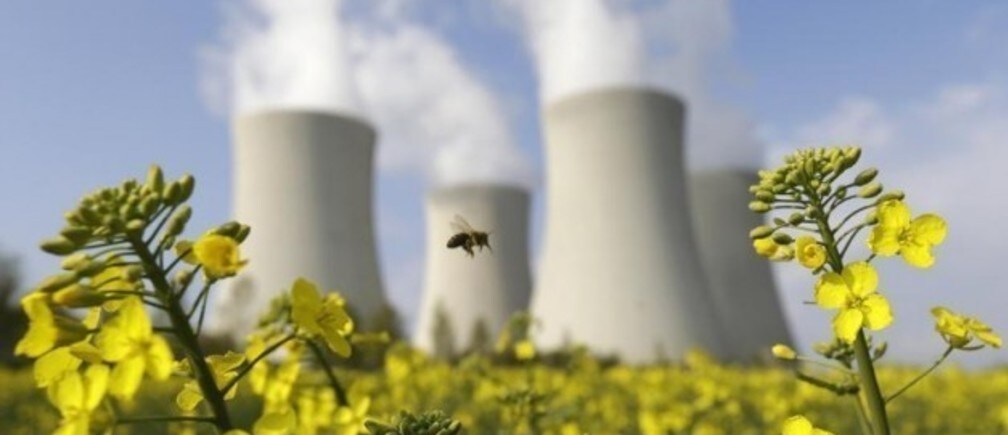
Image: A bee flies to collect pollen on a mustard field in front of the cooling towers of the Temelin nuclear power plant near the South Bohemian city of Tyn nad Vltavou. REUTERS/David W Cerny