By the end of 2021, there will be 4 billion people in the global consumer class with urbanization continuing to rise steadily throughout the next decade.
India remains the most dynamic market for urban consumers because it remains relatively rural even though it is urbanizing rapidly. Today India has an estimated 208 million urban consumers.
The fundamental forces of global megatrends will shape this decade and they will be most visible in Asia.
It is shopping time. Many people, especially in the Northern Hemisphere, participated in Black Friday and Cyber Monday while getting ready for Christmas. For many, the 2021 shopping experience also reflects a return to normality at a time of never-ending waves of COVID-19 infections and lockdowns.
Many large stores are in cities, which reflect two megatrends that are reshaping the global economy: the rise of the global consumer class and urbanization. Both megatrends experienced tipping points in this century. In 2008, the world became majority urban and in 2019, World Data Lab projected that half the world would be middle class or wealthier. By the end of 2021, there will be 4 billion people in the global consumer class, and, in the absence of another major economic crisis, the global consumer class will reach 5.2 billion people by 2030.
Urbanization will also continue steadily throughout this decade. People are moving from villages to cities to find better education, health care, and jobs. Additionally, in emerging markets, former villages are contributing to urbanization as they grow rapidly to the point that they represent a peri-urban segment. These are often the new suburbs of the world’s megacities such as Jakarta, Mexico City, Mumbai, São Paolo, or Lagos.
Urban areas are more prosperous than rural areas. Proximity breeds innovation and allows for economies of scale. In “Triumph of the City,” Edward Glaeser showed that cities are healthier, wealthier, and better for the environment because higher population density makes it possible to produce new goods and services at scale and thus at a lower cost for everyone. This is also why most of the global consumer class is now living in cities.
To estimate the urban consumer class, we use urbanization projections from the U.N. along with education and income measures and investigate how personal spending depends on each of these factors, especially urbanization. Projections for India are derived from survey microdata for the country.
World Data Lab projects that out of today’s 3.8 billion consumers, almost 3.2 billion (80 percent) are living in urban areas (see Table 1).
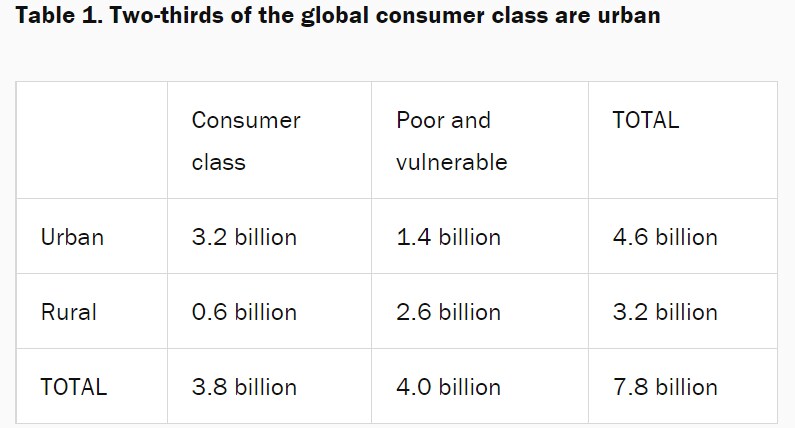
However, the split is uneven across countries as many emerging markets are still predominantly rural. In OECD countries, almost everyone is part of the consumer class. Since OECD economies are highly urbanized, approximately 80 percent of the OECD consumer class is urban. The same is true for emerging markets and developing countries but for different reasons. Poorer countries are still majority rural, but only a very small portion of rural folk are part of the consumer class. This means that among poorer economies also approximately 80 percent of consumers are in urban areas. In Asia where urbanization has been advancing rapidly, the urban consumer class dominates with 1.7 billion people, representing approximately 54 percent of the global urban consumer class. Asia’s consumer class is not only rising in China and India. There are also several emerging markets that are below the radar, especially Indonesia, Bangladesh, Pakistan, the Philippines, and Vietnam.
What's the World Economic Forum doing about the future of cities?
The Centre for Urban Transformation connects city leaders, businesses and governments to make sense of the challenges and opportunities shaping urban futures.
Through peer learning and collaboration, the Centre enables cities to exchange insight and translate shared understanding into practical, resilient urban solutions.
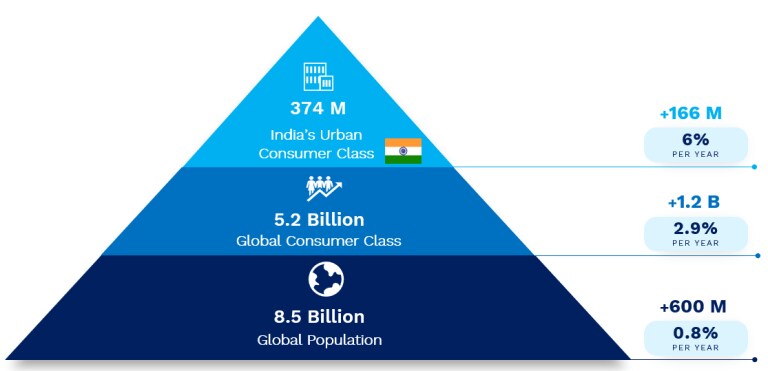
But India remains the most dynamic market for urban consumers because it remains relatively rural even though it is urbanizing rapidly. In India both megatrends converge on scale. Today India has an estimated 208 million urban consumers, which will rise to an estimated 374 million. This represents an annual growth of 6 percent. The growth of India’s urban consumer class is six times larger than global population growth, almost double growth of the global consumer class, and even substantially larger than the average of urban consumer class growth and Asia’s consumer class growth (see Figure 1).
Many of us will enjoy the festive season of the year looking back at two difficult years dominated by the COVID-19 pandemic. Despite the massive economic impact of COVID-19 in 2020, its impact has only been temporary. The fundamental forces of global megatrends will shape this decade and they will be most visible in Asia.