Global renewable energy capacity grew by 15.1% in 2024, largely driven by solar.
Yet a growth rate of at least 16.6% must be maintained to reach targets of tripling renewable energy capacity by 2030.
The World Economic Forum report Fostering Effective Energy Transition 2024 highlights which countries are best positioned for the energy transition.
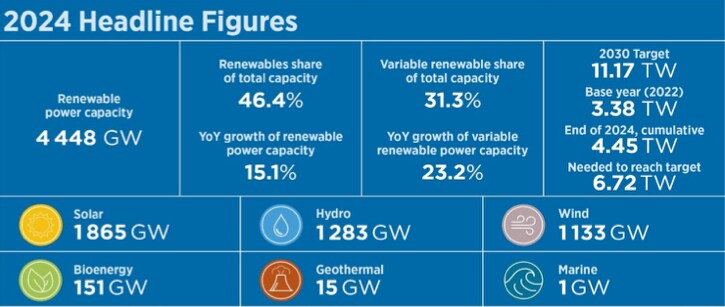
Global renewable energy capacity grew by a record-breaking 15.1% in 2024 to reach 4,448 gigawatts (GW).
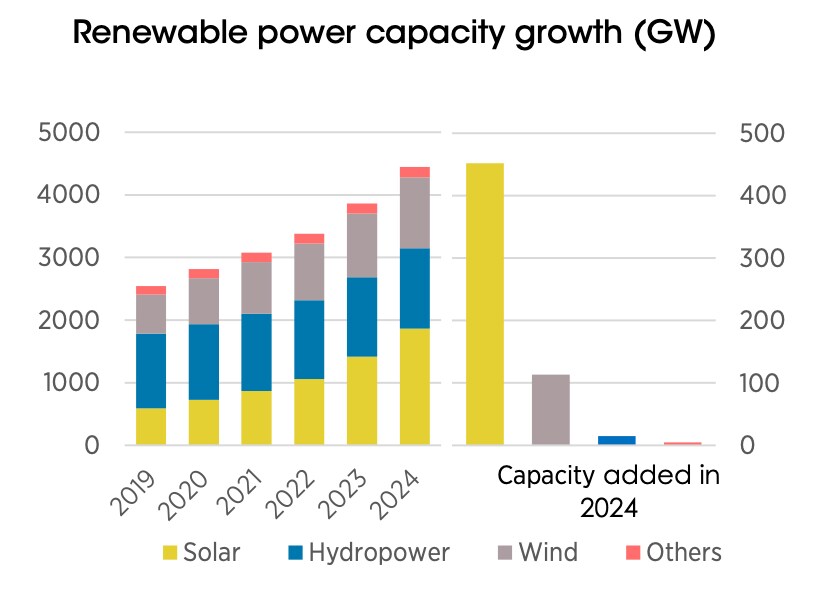
Around the world, an additional 585 GW of power was added, largely due to solar and wind energy expansion, figures released by the International Renewable Energy Agency (IRENA) show.
But despite setting a new high in annual capacity expansion, the growth still fails to reach the levels needed to deliver on the global goal to triple available renewable energy by 2030, IRENA cautions. This would require growing capacity at 16.6% each year until 2030.
“The continuous growth of renewables we witness each year is evidence that renewables are economically viable and readily deployable,” said IRENA Director-General Francesco La Camera. “Each year they keep breaking their own expansion records, but we also face the same challenges of great regional disparities and the ticking clock as the 2030 deadline is imminent.”
An uneven global picture
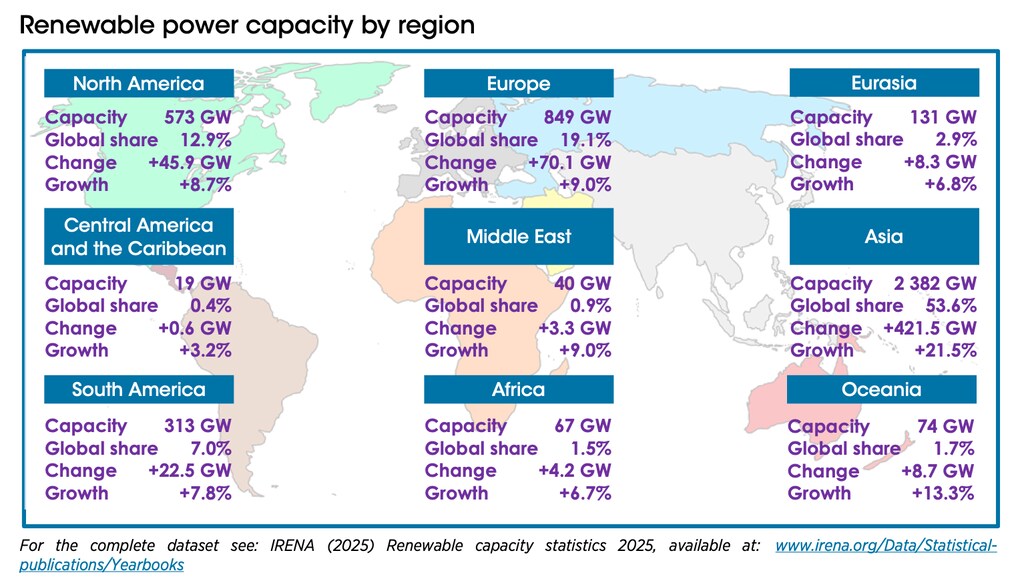
The regional disparities La Camera alludes to are longstanding. In 2024, as has been the case for a while, Asia contributed the greatest share – over two-thirds – of the increase, mostly driven by China. Asia is now home to over half of the world’s renewable energy capacity.
Central America and the Caribbean sit at the other end of the scale, contributing just 3.2% of the growth.
Europe expanded its capacity by 70.1 GW (9%), in large part due to significant growth in Germany. North America grew by 45.9 GW (8.7%) with a number of new installations.
The G7 and G20 countries led 14.3% and 90.3% of new capacity growth in 2024. This means that by the end of the year, the G7 (excluding the European Union) comprised just under a quarter of the global capacity share and the G20 (excluding the EU and African Union) accounted for four-fifths.
Small Island Developing States (SIDS) meanwhile are responsible for just 0.2% of the global capacity share, adding less new capacity last year than they did in 2023. Most of the new capacity from these nations was due to expansion in the Dominican Republic and Singapore.
Renewable technology highlights
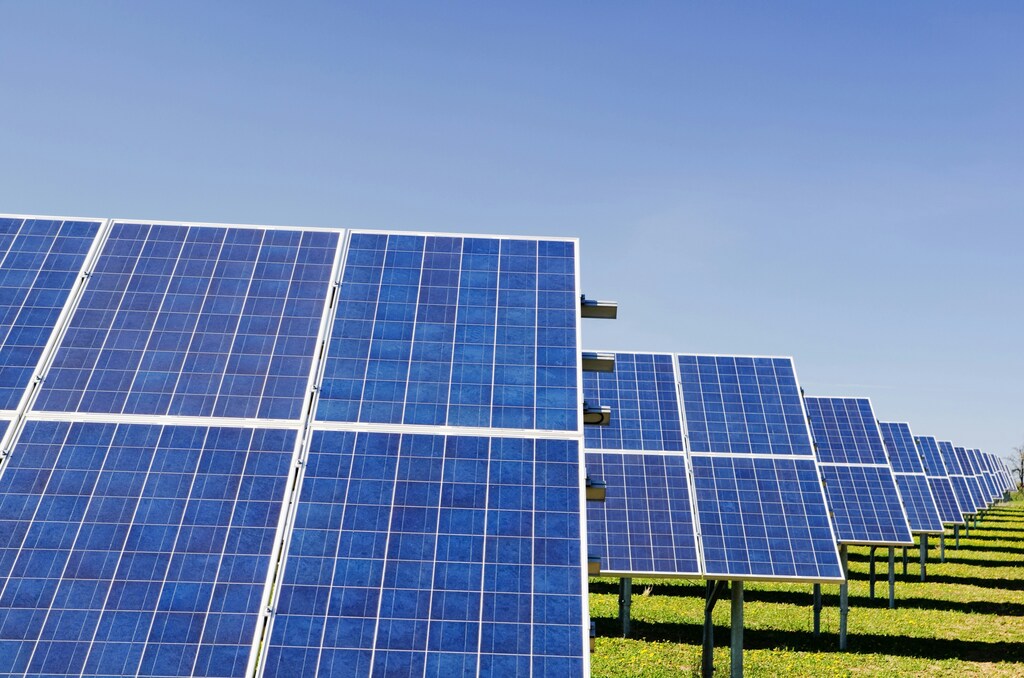
Over three-quarters of the new renewable capacity was down to solar, which grew by almost a third over the year. China, India and South Korea led the way here.
Wind accounted for the next largest chunk of growth, driven by China and the US.
Having slumped in growth in 2023, hydropower capacity reached 1,283 GW in 2024, again driven by China. In addition, Ethiopia, Indonesia, Nepal, Pakistan, Tanzania, and Viet Nam added more than 0.5 GW each.
China and France helped bioenergy capacity grow by 4.6 GW, while geothermal projects in New Zealand contributed to energy from this source growing by 0.4 GW overall.
Reaching renewable growth targets
Despite record renewable additions in 2024, current growth rates indicate the world is not on track to triple installed renewable power capacity to 11 TW by 2030 or meet Paris Agreement targets.
If we were to maintain the growth rate seen in 2024 we would still fall 7.2% short of the target; following the five-year growth trend since 2018 would leave us 27.9% short.
The World Economic Forum’s report Fostering Effective Energy Transition 2024 highlights how increasing global uncertainty is hampering the energy transition and testing energy security. It benchmarks 120 countries on the performance of their current energy systems, and how ready and enabling they are to the energy transition.

How is the World Economic Forum facilitating the transition to clean energy?
The Centre for Energy and Materials connects leaders to make sense of the complex transitions reshaping energy, materials and industrial systems. It provides a platform to explore how energy security, affordability and sustainability intersect.
Through collaboration across value chains and regions, the Centre enables shared pathways that help partners align around practical solutions for a secure, low-carbon and equitable transition.