Dark energy has topped cosmologists’ “most wanted” list since 1998, when astronomers noticed that the expansion of the universe is speeding up rather than slowing down. The entity responsible — whatever it is — must be incredibly powerful, constituting nearly 70 percent of the universe. Figuring out the identity of this dark energy is “arguably the most important problem in physics,” said Clare Burrage of the University of Nottingham in the United Kingdom.
Now a team of physicists has directly tested one option for dark energy using not powerful telescopes or satellites, but a vacuum chamber fashioned on a tabletop.
The most straightforward explanation for dark energy is that it is the energy inherent in the vacuum of space itself. In this model, every teaspoonful of space brims with the same amount of dark energy, a value known as the cosmological constant. But there’s a major flaw in this simple solution. Physicists’ best calculation of this energy, which is thought to be due to the constant appearance and disappearance of “virtual” quantum particles, overshoots the actual observed value by a factor of 10120.
So perhaps instead of — or in addition to — the cosmological constant, there may be extra quantum fields, called scalar fields, that have a given strength at each point in space, just as a measurable temperature exists everywhere.
Continue reading this article on Quanta Magazine. Publication does not imply endorsement of views by the World Economic Forum.
To keep up with the Agenda subscribe to our weekly newsletter.
Author: Maggie McKee is a freelance science writer who contributes to Nature, the BBC, Nautilus, Scientific American and others.
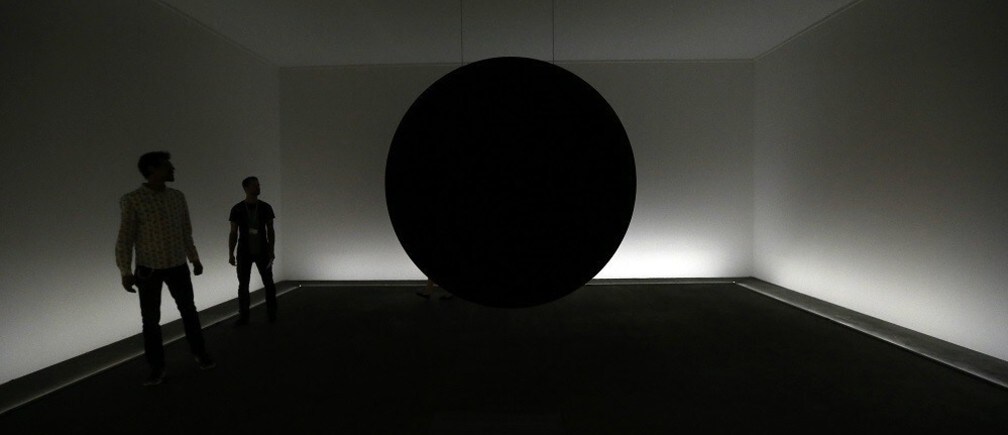
Image: Visitors look at the “Dark Matter” installation by Troika (2014) at the Art Unlimited exhibition at the Art Basel fair in Basel. REUTERS/Denis Balibouse