Labor productivity in developed countries can increase by 40% due to the influence of AI, according to analysis from Accenture and Frontier Economics.
Sweden, the U.S. and Japan are expected to see the highest productivity increases.
Despite this, 15% of companies in the global automotive industry recorded an AI-related decline of 3 to 10% in 2019 according to McKinsey.
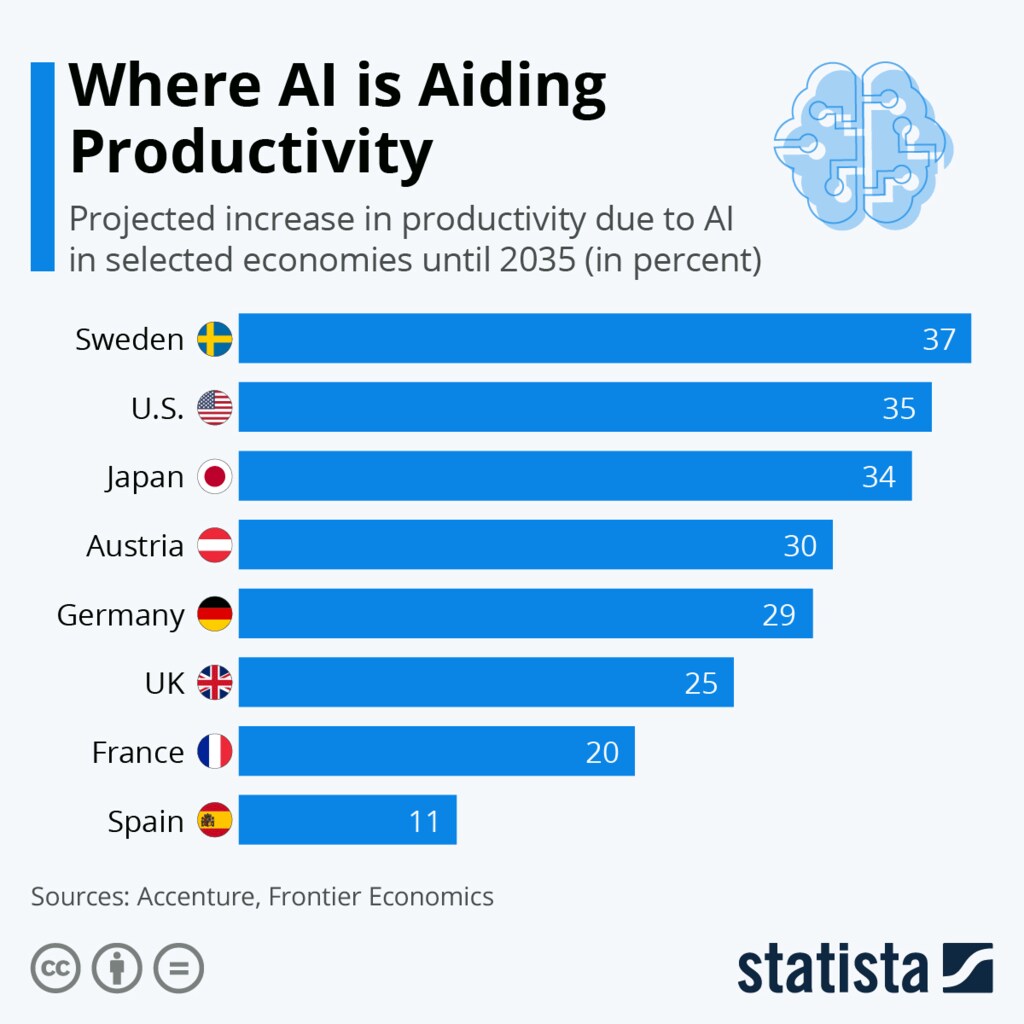
The use of artificial intelligence (AI) is already a reality in many industries, but the technology also has significantly more potential, as an analysis from Accenture and Frontier Economics shows. The report predicts that labor productivity in developed countries can increase by up to 40 percent until 2035 due to the influence of artificial intelligence. A high increase in productivity is projected in Sweden at around 37 percent. The U.S. (35 percent) and Japan (34 percent) are also expected to benefit greatly from the effects of AI. In Germany and Austria, AI can potentially maximize labor productivity by around 30 percent within the next 15 years.
Nonetheless, as automation advances, fewer unskilled workers will be required by industries, raising questions of what will become of these workers. According to McKinsey, 15 percent of companies in the global automotive industry recorded an AI-related decline in their workforces of 3 to 10 percent in 2019. Approximately 10 percent of companies even exceeded that number.