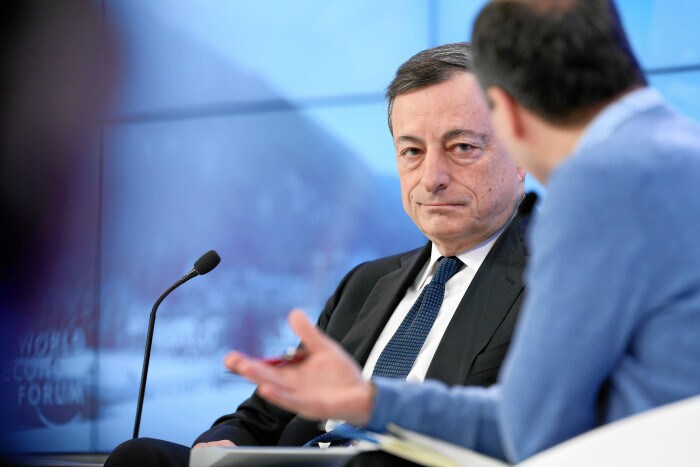
“We won’t give up,” said Mario Draghi, President of the European Central Bank, after a meeting of the Governing Council where the financial institution cast its first policy vote of 2016.
The message was clear: whatever the turmoil in the global economy – from falling oil prices to China-led slowdown in emerging markets – the ECB stands poised to step up its stimulus in March and defend growth in the Eurozone.
Speaking on the European economy at Davos, the president struck an upbeat tone. We might be short of the ECB’s 2% target for inflation levels, he said, but “we have the instruments – and we have the determination, willingness and capacity of the Governing Council to act and deploy them,” he told Lionel Barber, editor of the Financial Times.
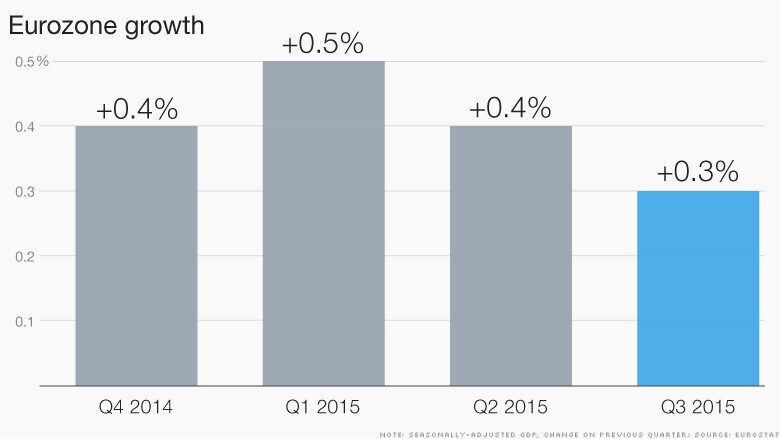
This chart from CNN Money shows how the growth rate in the Eurozone has tumbled over the latter half of 2015.
Even crises are an opportunity for action, according to the ECB chief, however complex the threats to EU stability from terrorist groups and the refugee crisis. “This union has become closer and closer, through one crisis after another,” he said. “All European leaders are trying to drive their people closer to the common European interest, in a way that is respectful of democracy.”
Progress in Greece
When it comes to a Greek exit from the Eurozone, we're in a better situation now than last June, says Draghi. The Greek government has made significant progress in reforms and fiscal consolidation. There are three areas of debate:
1. Setting the fiscal targets for 2018-19
2. Making pensions sustainable
3. Reforming the financial sector reforms.
Greek banks still have a high level of non-performing loans, but Draghi's advice to them is: "We need changes to legislation and processes by which these loans can be sold, so banks can give credit to the private sector."
Finally, the key to EU success is cooperation between countries. And this applies to economic growth as well as to how nations develop a common response to the threat of terrorism and migrant inflows. “A reasonable agreement will be found,” Draghi promised. “Not to cooperate means to ignore the challenge, and to ignore it will not make it disappear.”