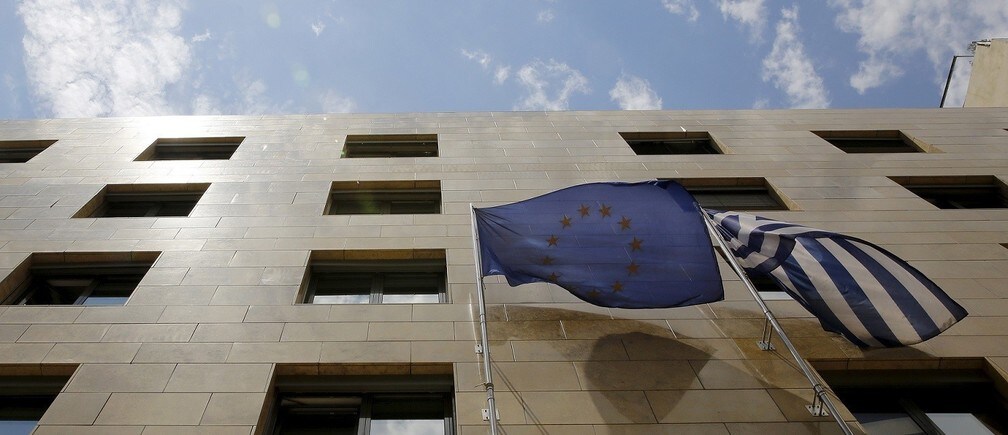
Greece looks contained.
On Monday, manufacturing data from Markit Economics showed that economic activity in Greece was stunningly low in July.
Markit’s purchasing managers index came in at a reading of 30.2. Any reading below 50 represents contraction in the sector, and readings near 40 represent a major crisis. Greece’s manufacturing sector was then 10 below that.
On some level, that shouldn’t have come as a complete surprise. After all, Greek banks were closed for much of the month, capital controls are in place, and the stock market was closed for the entire month of July.
The chart of this decline, however, is still stunning.

Markit
But Monday also saw the release of this data across the rest of Europe.
And the news on that front wasn’t just not bad, but decidedly positive.
Markit’s PMI reading for the eurozone as a whole came in at 52.4 for July, indicating solid expansion in European manufacturing, with Markit’s Chris Williamson writing, “The eurozone manufacturing economy showed encouraging resilience in the face of the Greek debt crisis in July.”
And what’s more, some of the peripheral eurozone members including Spain and Italy, who are most often seen as susceptible to contagion effects from any Greek crisis, continued to indicate expansion in their manufacturing sectors.
Italy’s manufacturing sector, in fact, in July turned in its best month in four years.
And in a note to clients after the report, analysts at Credit Suisse wrote, “Overall, this is a strong report for the Italian manufacturing sector across all components, suggesting that the sector started the third quarter on the right footing and seems to be completely unaffected from developments in Greece.”

Credit Suisse
Williamson added, “Policymakers will be reassured by the robust growth rates seen in these countries and the resilience of the manufacturing sector as a whole, especially as growth is likely to pick up again now that Greece has jumped its latest hurdle in the ongoing debt crisis.”
We recently noted that Spain’s far-left, anti-austerity party seemed to fall out of favor with voters in the week of the Greek crisis.
And now it looks as if the European economy has also moved on. Or maybe it never really blinked.
This article is published in collaboration with Business Insider. Publication does not imply endorsement of views by the World Economic Forum.
To keep up with the Agenda subscribe to our weekly newsletter.
Author: Myles Udland is Business Insider’s markets editor.
Image: A European Union flag (L) and a Greek national flag flutter at the entrance of the Bank of Greece headquarters in Athens. REUTERS/Yannis Behrakis.