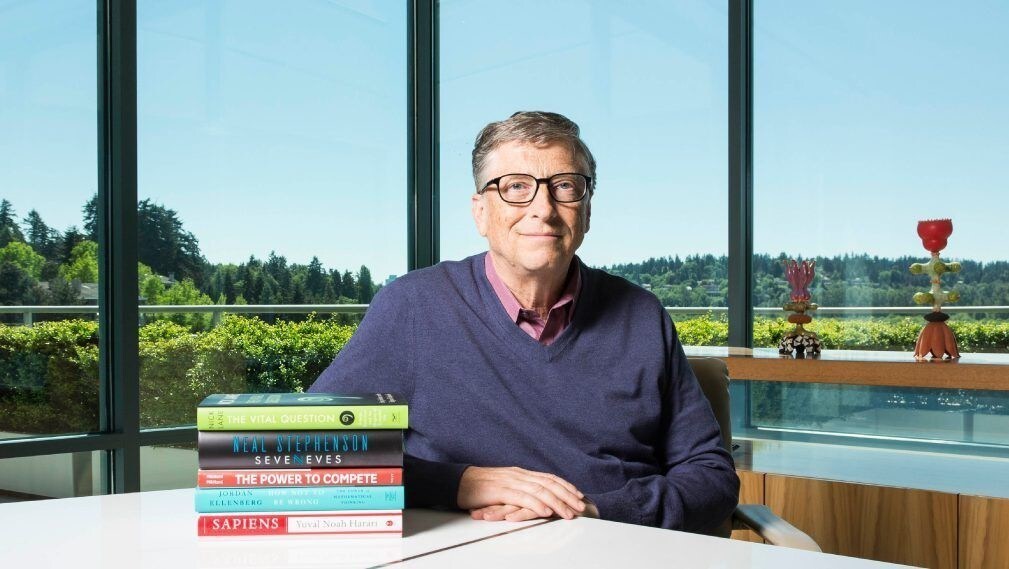
Balmy beach days usually send readers in search of juicy, fast-paced dramas, but for Bill Gates, the summer heat is equally great for nerdy escapism. In a new blog post the philanthropist, Microsoft co-founder, and insatiable reader recommended five math and science books to enjoy in the coming months.
Seveneves, by Neal Stephenson
An 800-page science-fiction novel about the human race after it is forced to leave Earth. Writes Gates, “You might lose patience with all the information you’ll get about space flight—Stephenson, who lives in Seattle, has clearly done his research—but I loved the technical details.”
The Power to Compete, by Hiroshi Mikitani and Ryoichi Mikitani
Rakuten founder and CEO Hiroshi Mikitani in conversation with his now late economist father, Ryoichi Mikitani, about how to revitalize the Japanese economy. “Although I don’t agree with everything in Hiroshi’s program, I think he has a number of good ideas,” writes Gates.
Sapiens: A Brief History of Humankind, by Yuval Noah Harari
Historian Yuval Noah Harari traces the human journey through its cognitive, agricultural, and scientific revolutions. “Both Melinda and I read this one, and it has sparked lots of great conversations at our dinner table,” says Gates.
How Not to Be Wrong, by Jordan Ellenberg
Math professor Jordan Ellenberg breaks down concepts grand and tiny to show how “mathematical thinking” can be applied anywhere. “In some places the math gets quite complicated,” writes Gates, “but [Ellenberg] always wraps things up by making sure you’re still with him.”
The Vital Question, by Nick Lane
Biochemist Nick Lane posits that a reliance on energy can explain the explosion from simple, single-cell life to complex forms. “Nick is one of those original thinkers who makes you say: More people should know about this guy’s work,” says Gates.