Inequality is driven mainly by corruption and a lack of transparency within governments, according to a survey of young people around the world.
The Global Shapers Annual Survey 2016 took the views of more than 26,000 millennials from 181 countries. Almost 60% of those surveyed said that corruption and a lack of transparency within governments was the biggest barrier to equal opportunities for all. That was in all five regions of the survey: Africa, the Americas, Europe, Oceania and Asia.
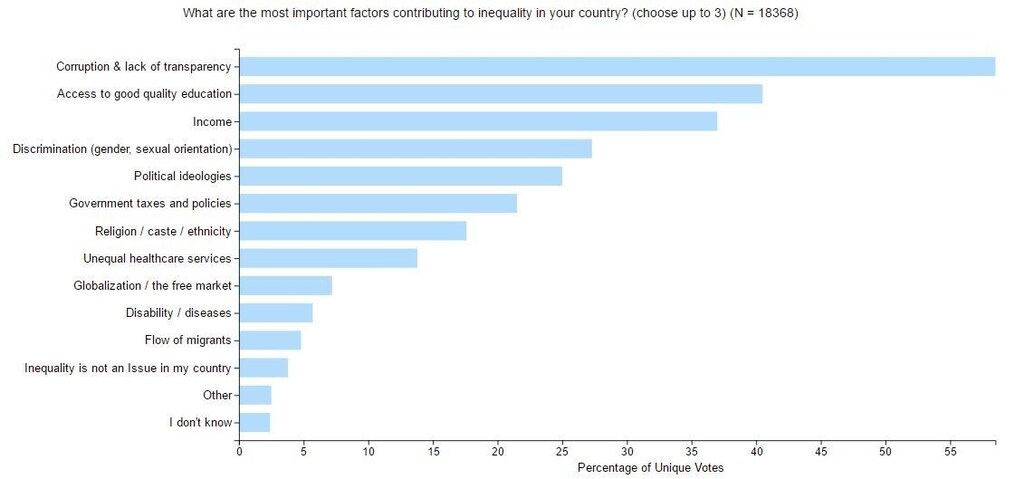
A lack of access to a good quality education was the second biggest barrier to equality, followed by income.
For young people in Africa and the Americas, a lack of access to quality education was a bigger driver of inequality. For their peers in Europe, Oceania and Asia, income was more significant.
Other major concerns are discrimination, political ideologies, government taxes and policies, religion, and unequal healthcare services.
Only 7.2% felt that globalization was a cause of inequality.
Corruption
World leaders agree that tackling corruption also helps address many other global problems, including poverty, economic development and inequality.
We know that corruption in developing countries affects poor people the most. It also impacts the way companies do business, often becoming a major constraint, particularly in the Middle East and North Africa, Latin America and the Caribbean, and sub-Saharan Africa.
Inequality is damaging to nations and the global economy. At its worst, it threatens social and political stability.
Education
Fifty-seven million children remain out of school, more than half of whom live in sub-Saharan Africa.
Access to good quality education, which came second on the list overall, is the fourth United Nations Sustainable Development Goal, which aims, by 2030, to “ensure inclusive and equitable quality education and promote lifelong learning opportunities for all”.
Education is about more than qualifications or test scores: it embodies children’s hope for the future. It is one of the keys to the fight against child marriage, for instance.
The young people’s concerns around inequality echo their general feelings about the world as a whole. Across all regions, young people see corruption and a lack of government accountability as the most pressing problem in their countries.
With many of the millennial generation defining themselves as global citizens (36%), the fight to tackle inequality is also a global one.
Have you read?
How corruption affects businesses around the world, in 5 charts
3 charts that explain global inequality