
Cycling is becoming an increasingly popular means of urban transport, thanks in part to an explosion in bike-sharing schemes in cities around the world.
These public bike-hire programs are generating a wealth of GPS tracking data that some city authorities have posted online. And now, researchers in Germany have found a clever use for some of this digital information.
Till Nagel and Christopher Pietsch have turned data from bike-share schemes in New York City, London and Berlin into visualizations. Their work, the cf. city flows interactive installation, is hosted by Potsdam’s Urban Complexity Lab.
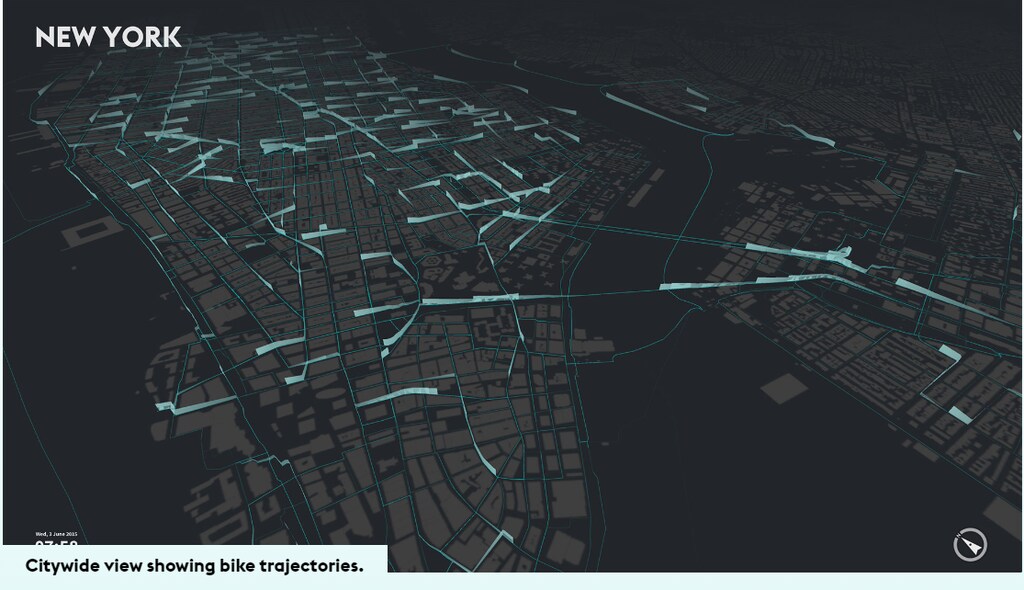
The installation features three high-resolution screens side by side that allow visitors to compare the flows of bike journeys in New York City, London and Berlin – with some interesting differences in patterns of movement.

As the project’s website points out: “Tracing urban movements accentuates different urban structures, and contrasts grid-plan cities like New York with historically grown cities such as Berlin.
“It also enables us to observe and dwell on similarities and differences in various bike-sharing systems.”
The bike-sharing boom
Although bike-sharing is not a new concept – it dates back to the 1960s – it’s currently growing at an unprecedented rate.
Today, there are more than 1,000 public bike-share schemes in more than 50 countries. By comparison in 2004, only 11 cities worldwide had such programs.
So what’s behind the bike-sharing boom? Alexandros Nikitas, Senior Lecturer at the University of Huddersfield in the UK, who has researched public attitudes towards bike-sharing, argues that better technology that helps city authorities to track and secure bikes has helped it catch on.
The low cost of the schemes, the fact they’re easy to implement compared with other transport infrastructure, and that they help boost the “green credentials” of local governments have also helped.
Have you read?
The global bike sharing boom: why cities love cycling schemes