
Flexible working arrangements are more likely to benefit women than men.
Joint research from Bain & Company and Chief Executive Women has found that women who work flexible hours are more likely to be promoted than men with similar arrangements. Men working flexible hours often feel discouraged and that their career has been jeopardized.
The survey of over 1,000 staff across Australian workplaces found that women who work flexible hours are better able to balance family and work life. “It’s clear that flexible working is a critical enabler to retaining women in the workforce,” argues the report.
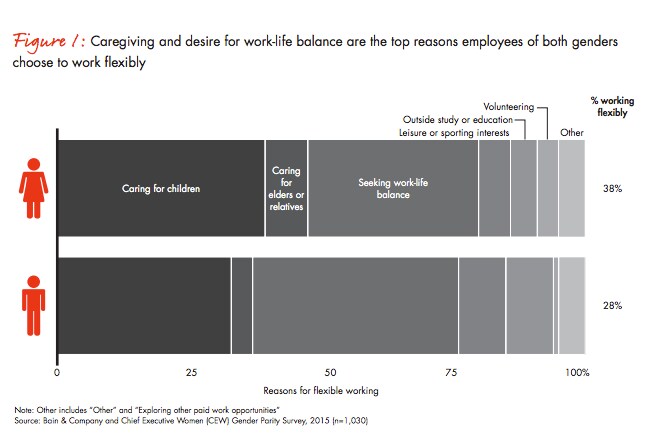
Flexible working was defined in the report as an organization allowing employees a measure of control over when, where and how they work. This included working part-time or from home, employees setting their own hours and the ability to take a leave of absence.
For both men and women, the main reasons for wanting flexible working hours are the same. Employees need to care for their children, look after elderly or sick parents, or just want a better work-life balance.
The report’s authors argue that flexible working options should be the norm – regardless of the reason. Technological advances mean most businesses can be run remotely, and “the way we work today is fundamentally different from how we worked a decade ago”.
But, significant hurdles still exist – particularly for men.
The results of the study suggest that women with flexible work arrangements are seen as more committed to achieving their potential, and are more confident about being promoted. However, for men, the system does not seem to have the same effect. One man questioned said he felt judged for the arrangement, while another was told he wouldn’t be promoted.
“This suggests that organizations have not yet cracked the code on how such arrangements work for male employees,” according to the report.
The findings are good news for women, though. As World Economic Forum research has shown, women still face significant workplace discrimination. At current rates of progress, the workplace gender gap will not be closed until 2133 and the average annual pay for women only equals the amount men were earning 10 years ago. Flexible working arrangements, if properly implemented for both genders, might help close that gap a little bit faster.
Have you read?
President Obama on the gender pay gap. How does your country compare to the US?
The Global Gender Gap Report in numbers
Do women work longer hours than men?