播客文字稿
This transcript has been generated using speech recognition software and may contain errors. Please check its accuracy against the audio.
Robin Pomeroy, host, Radio Davos: Welcome to Radio Davos, the podcast from the World Economic Forum that looks at the biggest challenges and how we might solve them. On this episode, this is a joint episode with China's CGTN, and I'm joined by an anchor and chief business news editor at CGTN, Xin Guan. Guan, how are you?
Xin Guan, anchor and chief business news editor, CGTN: I'm doing great, Robin, thank you for having me, and thank you the introduction.
Robin Pomeroy: CGTN is a very important broadcaster in China, just tell us what it is.
Xin Guan: Thank you. Well, we are an international broadcasting organisation and our team is the business news department. So our work is actually making sense of what's happening in the business and economy with the particular focus on China. So a big part of my role is mostly about how global audience to understand China's economic stories and how it connects with global economic trends. Great.
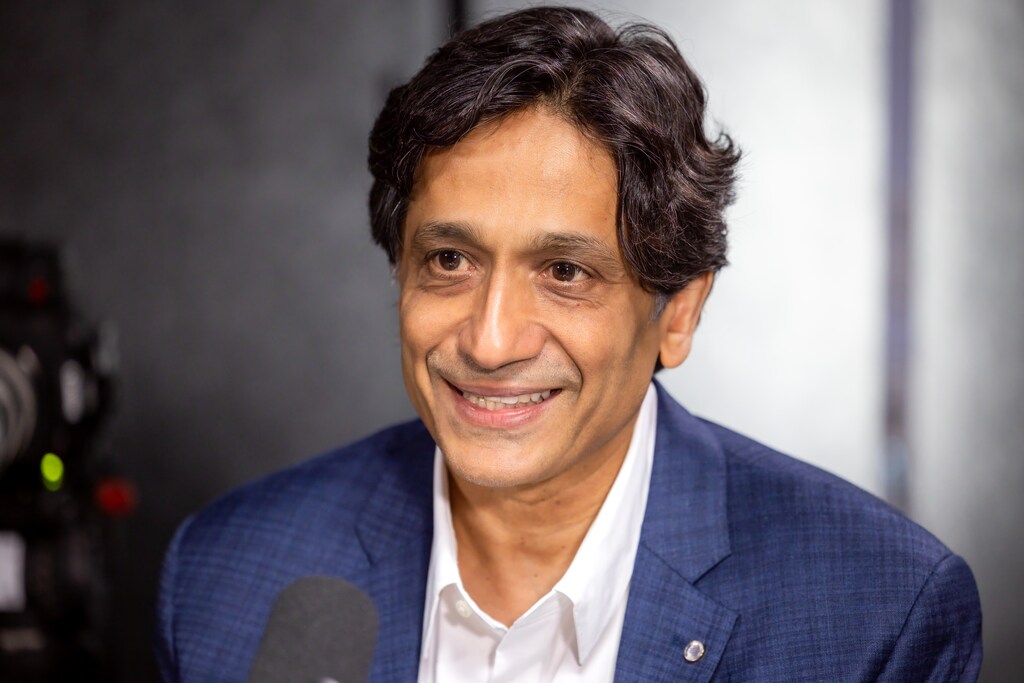
Robin Pomeroy: And you're joining me to interrogate our guest here, Arun Sundararajan. You are the Harold Price Professor of Entrepreneurship and Professor of Technology Operations and Statistics at New York University's Stern School of Business. Did I get that correct, Arun?
Arun Sundararajan, Harold Price Professor of Entrepreneurship and Professor of Technology Operations and Statistics, New York University's Stern School of Business: Yes, we academics, after a point, stop having new honorifics and so we keep extending our titles as sort of a feeling of like momentum.
Robin Pomeroy: Okay, we're going to get into this discussion about things you know a lot about, about employment and the change in the world of work. And I think everyone has lots of questions about that. You published a book ten years ago, we are not going to dwell on that because it was ten years ago, but it was called The Sharing Economy, The End of Employment and the Rise of Crowd-Based Capitalism. Just remind us what that book was about.
Arun Sundararajan: First off, thank you for having me on this. I'm really looking forward to this conversation. The book documented a new way of organising economic activity that I call crowd-based capitalism. It described how platforms ranging from platforms like YouTube at the time to Uber and Didi and Airbnb, Etsy, were reorganising how we provided things like retail, like transportation, like advertising. And instead of having large companies that employed people full time, paid them salaries and produced goods and services, a shift towards platform-mediated commerce, where you had customers on one side, crowds of providers on the other and the platform sitting in the middle.
Robin Pomeroy: Did that come to pass, that was a genuine shift in the world of work?
Arun Sundararajan: I believe so. I mean, you know, all of the statistics and a lot of people, when they saw that subtitle, The End of Employment, they assumed that I was talking about humans not having anything to do. That wasn't the implica- I mean maybe that's what my publisher wanted people to think and pick up the book with, but it was really about a change in the arrangement of work. Prediction was that work would be arranged less and less in the form of jobs or employment. And increasingly as non-employment work arrangements. We've seen that come to pass. When I wrote the book about 40 million Americans had some form of non- employment work arrangement. Last year, it was over 70 million. I was just told this morning by the chief economist of JD.com that over 40% of China's workers today are in non- unemployment work arrangements of some kind.
Xin Guan: We call it flexible employment, because it's actually becoming a very important part of China's employment landscape due to the importance of the sharing economy. We really need to keep up with this new form of employment, from social policies to training and social safety net. And I think it will be very interesting to watch the development in China because China have a very strong sharing economy development.
Arun Sundararajan: Absolutely. And I think that, you know, a lot of those questions around how do we protect the workforce? How do we give people a structure for progressing, you know, in their quote unquote careers, if it isn't provided by the organisation? All of these questions are actually, you know, this is not something that I explicitly predicted in my book, but they're definitely being amplified by the emergence of AI and, you know, sort of this sustained kind of attack of sorts on the structures of work that we had gotten used to over the 20th century.
Robin Pomeroy: Right, I mean, if you were to publish a book today with that provocative title, The End of Employment, everyone would assume you're talking about AI because there's a lot of fear about the displacement of jobs, particularly perhaps for entry level jobs. I'd really like to hear your take on that. Is it the end of employment because of AI?
Arun Sundararajan: Well, I certainly think we're going to see an acceleration in the change of work arrangements. I mean, let's sort of break this down into two or three different threads. First is this feeling that because this new generation of AI has capabilities that start to mimic what was the exclusive provenance of humans. To some extent, like the non-routine cognitive tasks, which have sort of spurred a lot of the income growth and benefits to people with college degrees. Now, AI can produce that kind of like non-outine cognitive work, but just because AI can do what a human does or a machine can do or a human doesn't mean that it will instantly start to do it in the place of the humans. That's the fallacy of technological determinism, that just because a machine can do it, it will immediately. So I think that we've got some time. There are lots of other factors that make this transition more viscous. In some ways, part of why we're seeing some impact on entry-level work is because there's so much uncertainty that organisations are feeling about what will the role of human beings be in the future, that a lot of them are just saying, well, let's hold back. Let's not hire people right now. Let's wait for this to shake out over the next two, three years and see where things land, what kinds of capabilities we want in humans. And so I don't think there's a lot of debate, at least in the United States, that there has been a slowdown in entry-level hiring. I think there is a very vibrant debate about what's causing it. There's a plausible story that it's generative AI. It's sort of broken the contract where a company would hire someone who was promising in an entry-level coding role, banking role, consulting role. They do fairly simple things, PowerPoint spreadsheets, routine coding, in exchange for being sort of like these investments that would be made into them to create the next generation of partners of expert coders of leaders. And now, because the generative AI can do... A lot of that sort of somewhat routine cognitive work, that contract is fragmenting. It's being compounded by the fact that the people who are acquiring these capabilities in college are not sure what the returns on these human capital investments are going to be. I think that there's a third factor which is we reorganised and restructured a lot of work during the COVID shutdowns because we had to sort of transition to work from home, remote work. And so we have to sort of structure things a lot. And I think that in some ways has lowered the return on these investments in entry-level workers because it's one thing if you're in the organisation five days a week and sort of absorbing from the senior people. It's another if you are in sort of strategically two or three days a weak. So there's a confluence of factors. I think, you know, anyone who tells you they know exactly. What kinds of work AI is displacing and what's going to happen sort of in the long run. I would not take too seriously, but I think that there's no doubt that there is going to be a lot of displacement over the next decade.
Xin Guan: I want to put it in the context of Asia's development, because we are very pragmatic about this, because Asia has the problem of ageing society, so on one hand we have this shrinking labour force, on the other hand, we have AI automation, so how will this interaction play out in the long term, could it be a good thing to complement the ageing society?
Arun Sundararajan: I think in the context of certain Asian economies, China, Japan, South Korea, where there has been this threat of a Japan, where has been both a potential and realised threat of an economic slowdown because of a labour shortage, AI and in particular the embodied AI, the robotic AI, is probably going to be a boon rather than a threat. Because it's going to play a big role in not, let me put that differently. The fact that we are seeing the kind of rapid progress that we're seeing in AI and robotics today is going to mean that the GDP slowdowns that would have occurred are not going to occur in these economies. And so it's actually very good news for Japan. Which has a long history of embracing robotics for China, which is far and away the world's leader in adopting industrial robotics. I read recently that more than half of the world industrial robots that were installed last year were installed in China. So there's sort of no question that there's both the need and the capability. I think that, you know, for the white collar workers, the people who do knowledge work, what I expect to see is a role compression of sorts, perhaps in Western economies as well, but more so in Asian economies, where a lot of things are delegated to AI. The set of things that the human does shifts to verification, problem formulation, certain kinds of judgement, certain kinds accountability. And it's the people who are able to demonstrate that they're good at this new class of non-routine skills. 100 years ago, muscle got automated. There was a certain kind of de-skilling as well, right? I mean, you had the skilled machinist, you had sort of the craft manufacturer, and that kind of skill was sort of put out of business by the machines and work became more routine. But there were other sort of cognitive capabilities that started to command the premium. So we're going to see a new cluster of capabilities that will command the premium. We haven't put our finger on exactly what that bundle is, but verify, you know, being able to know when to trust the machine, what to delegate to the machine. You know, how to exert the judgement that allows you to compliment rather than be substituted by the machine These will be the skills that the technological change will be biassed in favour of.
Robin Pomeroy: What do you say to your students at the University of New York who are trying to prepare? They'll want, obviously, the degree certificate, they'll get that presumably, you know, if they do their homework and pass the exams. But the skills they need and the kind of, when they go to those employers, if this period of uncertainty, as you're suggesting, it's not the end of employment for young people, but it's quite difficult at the moment and we don't know. What the outcome is, what the world's going to look like in five years time. So what do you tell them in terms of, okay, you've really got to nail this, this and this skill?
Arun Sundararajan: I tell them to run for the hills. No, I don't. I tell them that the way that I see artificial intelligence is as a technology that is going to create an incredible amount of value. And this is simply because the barriers to creating things of value have never been lowered so rapidly by any other technology. And I know that this sounds like a simple idea. Lowering the barriers to creating things of value, but that's really at the core of what's going to grow the economy. So how do they prepare themselves and how do the sort of make sure that they're on the sides of the winners rather than the losers? You know, and I've been telling them this for a while. One is to think like entrepreneurs and be entrepreneurs. If the barriers to creating thing of value have been lowered, go out and start to create them while you're a student. This will do two things. One, it creates a portfolio of what you're capable of. It sets you up to do something on your own, if in fact, the structure of work is not going to be employment. But it also sort of builds that muscle that allows you to be flexible and resilient and adaptable. And so if you're building that between the age of 18 and 22, that's going to... Like serve you in the long run. I also tell them simultaneously to position themselves to be AI force multipliers. So it's not like companies will not want any humans. In the short run, they may need fewer entry-level humans, but the ones that they need are going to be the ones who know how to dramatically increase their output using AI, and there will actually be a premium on that kind of human. And so make yourself an AI force multiplier, be an entrepreneur, sort of be adaptable, be flexible and build some resilience. I also tell them that networking has never been more important. Like, you know, a big part of your value in the future is going to be your set of connections. And so invest in that very heavily. There's never a better time to do that when you're a student, because you can always go up to someone and say, I'm a student. I'd like to learn from you. Once you're no longer a student that doesn't work as well. And so these are some of the things that I tell my students.
Xin Guan: It's called micro-entrepreneurship, right?
Arun Sundararajan: Absolutely, yeah.
Xin Guan: I think that is exactly what's happening in China because we have this open-sourced AI agent called OpenClaw and it just went viral in China and people start their own company just of his or her own and we call it a one-person company and he deployed several AI agents working for him. And what's interesting is in the past, if you are an IT student, it's easier to start a business because they know how the internet works. They know how to code. And now if you study literature, philosophy, but you can just tell AI agents what you want to do. Tell it about your vision. And they're just starting a company. I think that is a very interesting trend. So maybe we can be less concerned about the job losses and thinking about new ways to create value for the society.
Arun Sundararajan: Absolutely, and I think that there's going to be a lot more people who earn their livings as not working for someone else, but creating things of value, working by themselves. And the early indications are the people who can harness the agents certainly have a leg up. I do think that it's going be a very substantial adjustment for countries. It's going require a rethinking of industrial policy. It's going to require a rethinking of the structures that we put in place to allow people to feel like they are progressing, the structures to provide people with benefits and a safety net. And, at least over the next decade, I think that there may be a call to come up with new ways to redistribute. And I'm hoping we're going to get beyond the ideas of an AI tax or a universal basic income. We can get to sort of some other ideas where I feel like the economists have to do better than, you know, tax or UBI. But I think redistributive mechanisms are going to be needed in the near term to make sure that as we get to that eventual destination of massive value creation, the process is not too painful for a significant fraction of the workforce.
Robin Pomeroy: It'll change education as well, do you think?
Arun Sundararajan: I think it's already started to change education, certainly college education. I mean, every university I speak to is in some ways thinking about what can be delivered using AI. And then of the time that's freed up, how do we double down on, you know, sort of smaller group experience, more experiential learning, more entrepreneurial type things that prepare students better for the future.
Robin Pomeroy: It's quite an optimistic view, I think. We won't all be put out of work, but things are going to change.
Arun Sundararajan: Yep, there's going to be a not-so-nice process of adjustment. But we saw this in many ways at the turn of the 20th century. There was a whole sort of hay farming and oats kind of industrial complex that there's
Robin Pomeroy: The oil of its day, I assume, it was fuelling transport.
Arun Sundararajan: Absolutely. And so that infrastructure had to be, you know, there were people who over a generation, you know had to find something else to do. The gasoline powered, you know, machines that put a lot of farmers, that mechanised a lot of farming and dramatically reduced the number of people who could earn a living as an independent farmer. And so it wasn't a painless process and we think of where it took us, but we are beginning a more accelerated version of that.
Xin Guan: What role should the government play in this process to manage these challenges in the transition?
Arun Sundararajan: That's a great question. I think it depends on what part of the world you're talking about and what role the government historically does play, I think because the answer for China is probably going to be different than the answer from Germany and the answer from the United States. At a high level I think government should be thinking about ways in which they can facilitate transition. You know, educational infrastructures have generally been to prepare people for the beginning of their work life, K-12 education, college. What we need are infrastructures that allow people to shift, because entry-level work is what's being threatened now, but there's going to be a lot of mid-career transition in the pipe. And most of the glory comes from creating Tsinghua University, right? Not creating a network of community colleges that transitions people in their 30s and 40s. But I think governments need to invest very heavily in making sure that people can make that shift. I do think the innovative governments will think carefully about how do we make sure that the value that is going to be created by AI is equitably distributed, the income and wealth value that is created by Ai is equidably distributed to some extent. I think it's also useful for a government to champion the non-income, non-wealth. Equalising effects of a technology like AI in education, in health care, in access to opportunity, much like digital technologies equalised, you know, access to entertainment, access to communication, AI will equalise access to a whole bunch of different things. And so having the population having a mindset that this is helping them. While also making sure that there's some redistributive mechanism that is preventing too much income and wealth inequality from emerging.
Robin Pomeroy: You mentioned Guan, government's role, so maybe we can move the conversation on now to the governance of AI.
Xin Guan: Absolutely. A critical conversation.
Robin Pomeroy: Go ahead. What would you like to know from Arun about governance?
Xin Guan: Yes, as Arun just mentioned, there are different approaches around the world and China definitely has its own approach. I know you are an advisor to the Internet Society of China. You've been observing the development of China's sharing economy. Will these unique characteristics carrying on to the age of AI?
Arun Sundararajan: I think they will. Let me put that into context. In many countries that are not China, over the last 15 years, we've seen a redistribution of governance power between governments and private entities. And so a lot of the roles that used to be played by government, whether it is on different things around what kind of content is accessible to people who can observe. Who provides infrastructure, who is responsible for the technologies that facilitate security. A lot of those roles shifted away from government and towards platforms. And this happened sort of de facto in many ways. And as a consequence, if I look at the US today, a lot of governance has to be done by the companies because we're in a world where that is the system. Now, if you look at China on the other hand, there has been much more of a top-down approach to platform governance. There's been more active algorithmic governance, where there's better visibility into how the algorithms are worked and governed. I think that there's been much more robust industrial policy, much stronger sort of planned industrial policy that is much more broad-based. So that it's not just a lot of innovation in a few areas, but it's across the board, robotics, solar, electric vehicles, not just sort of generative AI. And so I expect that that blueprint of top-down, of sort of active algorithmic governance, of situating it in a broader industrial policy so that there's not over-capitalization in any particular sort of slice of technological innovation. So no disorderly allocation of capital in some sense. And then finally, I guess, the system where a lot of what happens is through administrative directives rather than through a courtroom battle, which is much more in other countries. I think a lot that is going to carry over to AI governance. And so you'll probably see AI governance structure settle in China much sooner than in the EU and certainly much sooner than the United States.
Robin Pomeroy: In the United States we had this Anthropic Mythos affair, what's the word, where it seemed to be that the current US administration had a pretty much laissez-faire attitude, or to put it another way, was leaving it up to these platforms to work it out, not trying not to put regulatory barriers in their way. And then you had Mythos from Anthropic, which the company itself said was potentially too dangerous just to release widely. And then it released it to certain people, released it the US government. And now the US government has imposed certain restrictions. On it, if you remind us exactly, you'll probably follow this closer than I have, what's happened there and what does this say about US AI governance?
Arun Sundararajan: Okay, I think it's a fascinating case study and it's one of the most important early case studies on how AI governance will play out in the United States. So as you point out, the original, quote unquote, governance of Mythos had to do with its code generating capabilities being so advanced that it posed a threat to the computer security. Of like not just the country but of the globe in terms of this capability could be harnessed to hack into any system. And so over there you saw an illustration of this platform government talents where the platform proactively said as a responsible actor we are not going to release it. Now we're in phase two of Mythos where the US government has decided that it may a threat to national security for non-U.S. citizens. Not just people in other countries, but non-U.S. citizens to have access to it. And Anthropic has made the choice to simply not make it available to anyone, in part because it's complicated. They have a number of non-US citizens who work for them. So technically these people are not supposed to have to access to Mythos at this point. So I think what this is telling us is that we're in some ways in uncharted territory when it comes to who's going to be making the decisions and what these decisions are going to be. I think the U.S. government certainly feels like we're at a moment where we need a different approach to controlling what gets put out there in terms of frontier models, not just from a national security point of view, but just from, you know, we don't know the unintended consequences of widespread access to technology as powerful as this. And so I expect that over the next year or two we're going to have more incidents like this where we're going to be making it up as we go along in a sense and it's going to both the government doing that and the platforms doing it.
Xin Guan: I think from China's perspective, we heard too much national security concerns of the United States, from export controls to advanced chips and now advanced AI models. And at G7, and they were talking about trusted allies will be granted access to their most advanced AI model. So that really speaks to the necessity of AI sovereignty issue. This cross-border technology cooperation is facing the challenge of more fragmentation, especially due to geopolitical tensions. So how do you see the future about AI cooperation going forward? It seems the United States is building walls around it. China on the other side is advocating open-sourced global collaboration. So your thoughts on that?
Arun Sundararajan: It's helpful to think about AI sovereignty in the broader context of what's happened with digital sovereignty over the last 10 or 15 years. There has been a recognition by many countries that part of a nation's strategic autonomy is going to be shaped by having some indigenous digital capabilities or not being too dependent on a different nation state for critical digital infrastructure. And AI happens to be the latest such digital infrastructure. And I think both the US and China and to some extent the EU. I mean, the US has, you know, without explicitly saying we want to be digitally sovereign has, gotten used to being the leader in different technologies and just assuming that they will always have access to these technologies because it's their companies producing them. I think China has proactively invested and implemented industrial policy that has made it a separate digital leader. If you look at the rest of the world, it's very unlikely that any other country is going to have anything resembling blanket AI sovereignty, where everything is produced by the country. I personally don't think that that's necessary or pragmatic. I don't any country has full stack AI sovereignty anyway. We have semiconductor dependencies, manufacturing dependencies, cloud dependencies. I think the US and China will come up with their own ways of drawing a circle around what is autonomous and what preserves their strategic autonomy. For most of the rest of the world, it's going to have to be making choices about what layer I'm going to gain autonomy in, because nobody else is going to be able to make the semiconductors themselves. It may not be in the best interest of most countries to say we want our frontier models to be domestically produced. This may not the best thing for their citizens, right? And so it's really a question of what is the layer of AI that is most important for me to have strategic autonomy? Should I do it completely by myself or should I form an alliance? I think for smaller countries, this is certainly sort of a valid question. And an aspect that I've seen surprisingly be of considerable importance to a lot of countries is the issue of cultural autonomy, which has less to do with sort of, I want the technology to be domestically produced so I can preserve my bargaining power, but more about I don't want a foreign technology teaching my second graders in AI-enabled classrooms, because I want the culture that they learn when they're in school to be my country's culture. So there are no easy answers here. I think that there's an argument to be made for openness. There's also an argument to be against openness from a security point of view. So it all remains to be seen.
Robin Pomeroy: Just going back to the jobs for a moment, there is a concern that we might lose a generation to AI. What do you say about that?
Arun Sundararajan: Well, for the generation that is in high school, in college, just starting their careers, it's a difficult time. Whether we lose this generation to AI is going to depend in part on the generation. Unfortunately for them compared to people who were in their position 10 years ago, there isn't a predictable path to starting their career. It's something they're going to have to make up as they go along. So it's going to take a lot more resilience and adaptability. I do think that during this period of adjustment, the uncertainty will be overwhelming for a fraction of them. But I think for a faction of them, they will look back in 10 years and say, this was a period of such a great opportunity compared to 2016 where everything was stable and predictable.
Robin Pomeroy: Arun Sundararajan, thanks so much for joining us on Radio Davos and on CGTN.
Arun Sundararajan: Thank you for having me. This was such a fabulous conversation.
Robin Pomeroy: And thanks to Guan. It's been great to collaborate with you.
Xin Guan: Yes, it's very interesting and I hope I can join you again in the future.
Robin Pomeroy: It would be great. You can find Radio Davos wherever you get podcasts or go to wef.ch/podcasts where you'll find all the forums podcasts including Meet the Leader and Agenda Dialogues. Thanks very much to Arun, to Guan. Thanks to you for listening and Radio Davo will be back very soon. Goodbye.
For today's undergraduates, the impact of artificial intelligence on the jobs market means massive job uncertainty. So how should young people prepare themselves for the unknown unknowns of a career in the age of AI?
"The uncertainty will be overwhelming for a fraction of them, but I think for a fraction of them they will look back in 10 years and say this was a period of such great opportunity," says Arun Sundararajan, a professor of entrepreneurship, technology operations and statistics at New York University's Stern School of Business.
This episode was co-produced with China's CGTN and co-hosted by Xin Guan, CGTN anchor and chief business news editor.
Related podcasts:
每周为您呈现推动全球议程的紧要问题(英文)
Qiqing He and Yves Zumbühl
2026年9月7日